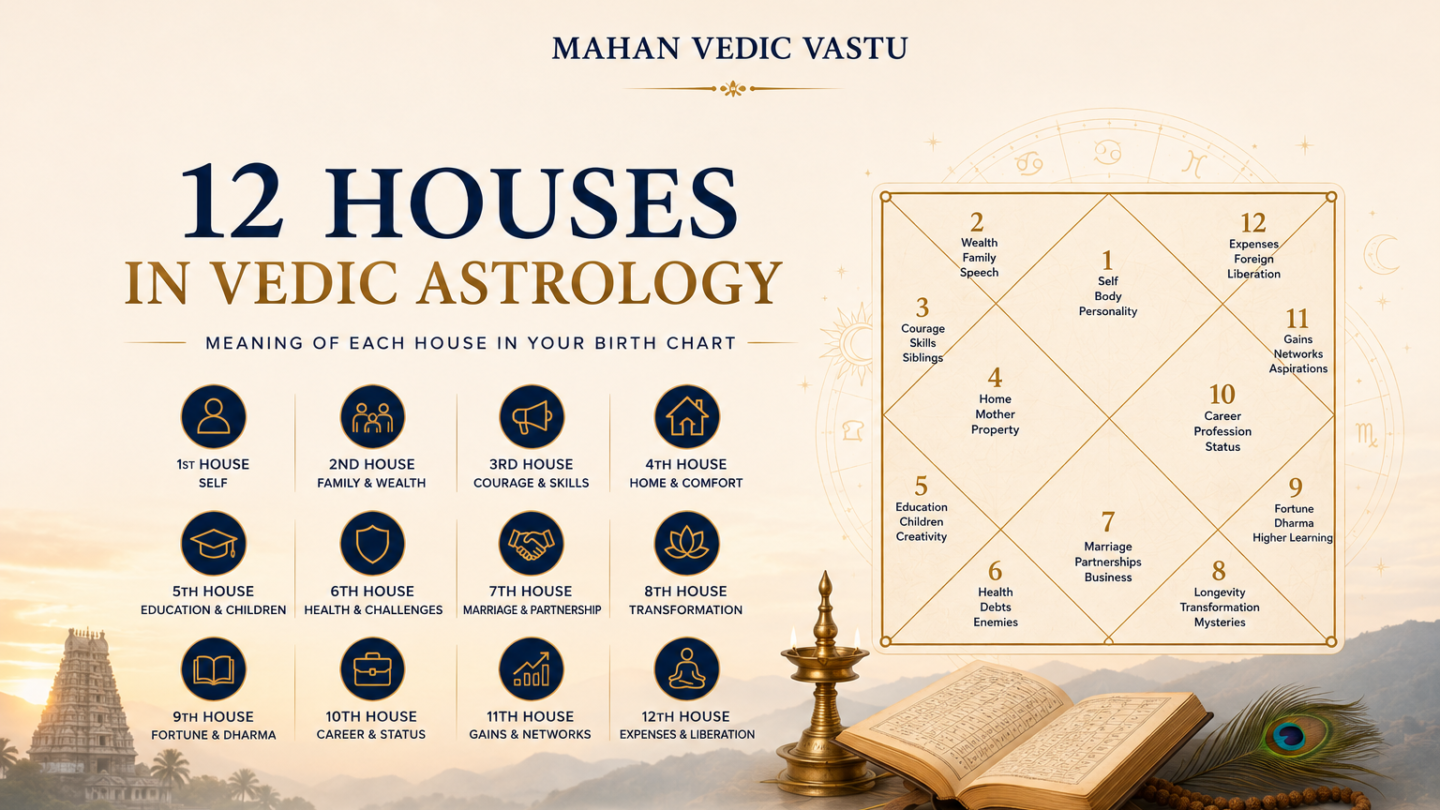
A Vedic birth chart is divided into twelve houses, traditionally known as Bhavas. Each house represents a particular field of life—from personality, family and wealth to education, marriage, career, gains, challenges and spiritual development.
Understanding these twelve houses is one of the foundations of Vedic astrology. However, simply knowing that the 7th house represents marriage or the 10th house represents career is not enough for a complete interpretation.
A proper birth chart analysis considers the house, the zodiac sign occupying it, its ruling planet or house lord, planets placed in the house, planetary aspects and associations, strength and dignity of the planets, relevant yogas, and the planetary periods that activate those combinations.
This is why two people can have a planet in the same house yet experience very different results.
What Are the 12 Houses in Vedic Astrology?
The twelve houses form the structural framework through which different areas of human life are studied in a horoscope. Classical vedic Jyotish literature treats the Bhavas as fundamental components of chart interpretation.
The houses begin from the Lagna or Ascendant, which establishes the first house. The remaining houses are then counted sequentially.
In simple terms:
Planets indicate the forces operating in the horoscope.
Signs influence how those forces express themselves.
Houses indicate the areas of life in which those influences operate.
Therefore, a meaningful horoscope interpretation requires these factors to be read together rather than independently.
Why Is the Lagna Important in a Birth Chart?
The Lagna (Ascendant) is the zodiac sign rising at the eastern horizon at the time of birth.
It establishes the first house and therefore determines the arrangement of the remaining houses in the horoscope.
Because the Ascendant depends on the birth time and location, accurate birth details are especially important when constructing a horoscope.
The Lagna and Lagna lord are among the first factors examined when understanding a person’s physical constitution, temperament, vitality and overall direction of life.
Meaning of the 12 Houses in Vedic Astrology
1st House – Self, Body, Personality and Life Direction
The 1st house, or Tanu Bhava, represents the individual.
Important significations include:
- Physical body
- Appearance
- Personality
- Temperament
- Vitality
- General health
- Self-expression
- Personal identity
- Approach towards life
- Overall life direction
The first house is also the Lagna house, making its lord particularly important in the horoscope.
A strong Lagna alone does not guarantee an effortless life, but the condition of the Lagna, its lord and influencing planets provides important information about how the individual approaches life’s opportunities and challenges.
2nd House – Wealth, Family, Speech and Savings
The 2nd house, commonly known as Dhana Bhava, is associated with accumulated resources and family foundations.
It is studied for matters including:
- Family
- Accumulated wealth
- Savings
- Speech
- Communication style
- Food habits
- Values
- Early family environment
- Possessions
For financial analysis, the second house should not be considered alone. Its lord, planets influencing it and its relationship with houses connected with income, profession and gains must also be examined.
3rd House – Courage, Communication, Skills and Siblings
The 3rd house, or Sahaja Bhava, is closely associated with self-effort.
Its significations include:
- Courage
- Initiative
- Communication
- Writing
- Skills
- Talents
- Younger siblings
- Short journeys
- Enterprise
- Personal effort
It is an important house when assessing whether a person is inclined to take initiative rather than wait for circumstances to change.
The third house is also classified as an Upachaya house, traditionally associated with areas that can develop through effort and experience.
4th House – Mother, Home, Property, Vehicle and Inner Happiness
The 4th house, or Sukha Bhava, represents the foundations of emotional and domestic life.
It is associated with:
- Mother
- Home
- Residence
- Property
- Land
- Vehicles
- Domestic comfort
- Emotional security
- Inner happiness
- Foundational education
Property or vehicle predictions should never be made merely because the fourth house appears favourable. The fourth lord, relevant significators, planetary combinations and timing must also support the event.
5th House – Intelligence, Education, Children, Creativity and Love
The 5th house, traditionally called Putra Bhava, represents intelligence, creativity and several important expressions of personal development.
It is studied for:
- Intelligence
- Learning ability
- Education
- Children
- Creativity
- Romance
- Love
- Mantra
- Speculation
- Past merit
- Intellectual expression
The fifth house is one of the important Trikona houses.
When studying education, children or romantic relationships, an astrologer examines the fifth house together with its lord, relevant planetary significators and other supporting houses.
6th House – Health, Debts, Competition, Service and Enemies
The 6th house, or Ari/Ripu Bhava, represents situations requiring effort, resistance and problem-solving.
Its traditional significations include:
- Disease
- Debts
- Enemies
- Competition
- Disputes
- Service
- Employment conditions
- Obstacles
- Daily work
- Conflict
The sixth house can therefore describe difficulties, but it can also indicate one’s capacity to confront competition and overcome opposition.
It belongs to both the Dusthana and Upachaya classifications in commonly used Vedic house groupings.
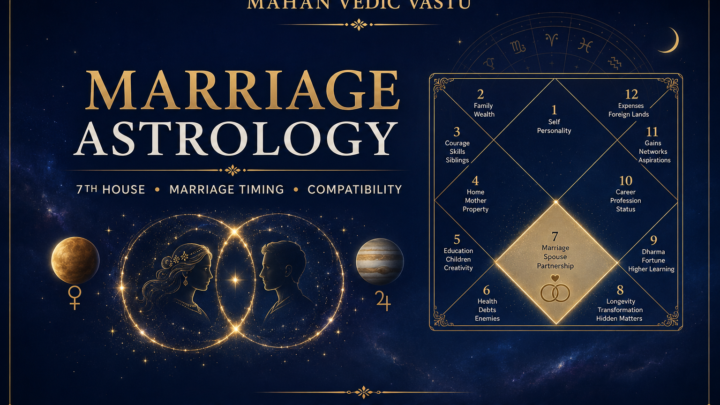
7th House – Marriage, Spouse, Partnership and Business
The 7th house, traditionally associated with Kalatra Bhava, stands directly opposite the first house.
While the first house represents the self, the seventh deals significantly with one’s interaction with others.
It is examined for:
- Marriage
- Spouse
- Long-term relationships
- Partnerships
- Business partnerships
- Contracts
- Public dealings
- One-to-one relationships
For marriage analysis, examining only the seventh house can produce an incomplete conclusion.
The seventh lord, planets occupying and aspecting the house, Venus or other relevant significators, Navamsa and appropriate planetary periods should be integrated into a broader analysis.
For a personalised interpretation of marriage, career, finances and other areas of your horoscope, you can choose a professional Astrology consultation.
8th House – Longevity, Sudden Events and Transformation
The 8th house, commonly known as Randhra Bhava, is one of the more complex houses in Vedic astrology.
It can relate to:
- Longevity
- Sudden developments
- Major transformations
- Hidden matters
- Secrets
- Inheritance
- Joint resources
- Research
- Occult subjects
- Chronic or prolonged difficulties
The eighth house should not automatically be interpreted as negative.
Depending on its lord, planetary influences and connections with other houses, it can participate in very different outcomes, including research, inheritance, transformation and unexpected developments.
9th House – Fortune, Dharma, Father and Higher Knowledge
The 9th house, or Dharma Bhava, is an important Trikona house.
Its significations include:
- Dharma
- Fortune
- Father
- Guru
- Higher education
- Philosophy
- Spiritual knowledge
- Long-distance journeys
- Ethics
- Higher principles
- Blessings and guidance
The ninth house is especially important when studying the person’s belief system, higher learning and relationship with teachers, mentors and guiding principles.
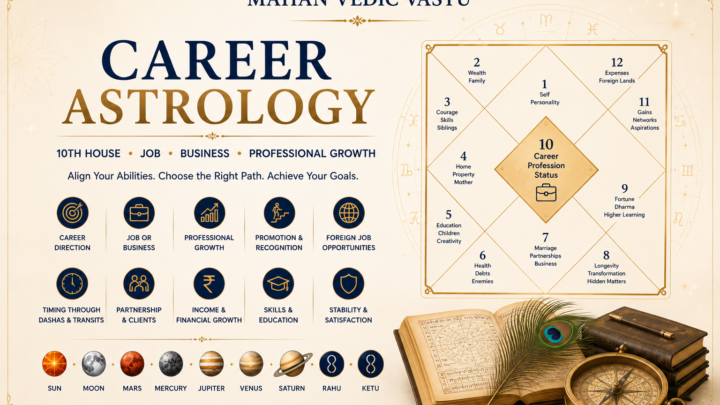
10th House – Career, Profession, Status and Authority
The 10th house, commonly known as Karma Bhava, is one of the principal houses examined for profession and public life.
It represents areas including:
- Career
- Profession
- Work
- Responsibility
- Authority
- Reputation
- Public standing
- Achievement
- Leadership
- Actions in society
However, saying that the tenth house alone decides someone’s profession is an oversimplification.
Career analysis can involve the tenth lord, planets in or aspecting the tenth house, connections with income and service houses, planetary strength, divisional charts and the planetary periods operating at different stages of life.
11th House – Income, Gains, Networks and Fulfilment of Desires
The 11th house, or Labha Bhava, is principally associated with gains.
Its significations include:
- Income
- Gains
- Profits
- Elder siblings
- Friends
- Networks
- Social connections
- Aspirations
- Achievement of objectives
- Fulfilment of desires
The eleventh is another Upachaya house.
For financial interpretation, connections between the second, tenth and eleventh houses can be especially relevant because savings, professional activity and gains describe different dimensions of financial life.
12th House – Expenses, Foreign Lands, Isolation and Spiritual Liberation
The 12th house, or Vyaya Bhava, completes the sequence of the horoscope.
Its traditional significations include:
- Expenses
- Loss
- Foreign lands
- Isolation
- Seclusion
- Sleep
- Charity
- Spiritual withdrawal
- Detachment
- Liberation or Moksha
The twelfth house illustrates particularly well why houses should not simply be labelled “good” or “bad.”
Materially, it may represent expenditure or separation. In another context, the same house is associated with retreat, charity, spiritual practice and liberation.
Important House Classifications in Vedic Astrology
The twelve houses can also be studied through traditional groupings.
Kendra Houses – 1, 4, 7 and 10
These are the angular houses and form major structural pillars of the horoscope.
Trikona Houses – 1, 5 and 9
These houses are associated particularly with Dharma, merit and supportive developmental patterns.
Upachaya Houses – 3, 6, 10 and 11
Upachaya houses are traditionally associated with matters that can develop or improve through time, effort, experience and maturity.
Dusthana Houses – 6, 8 and 12
These houses can represent challenges, difficulties, transformation, loss and circumstances requiring adjustment.
Yet a Dusthana should never automatically be labelled “bad.” Its actual results depend upon the complete planetary configuration. These conventional classifications are widely used in Vedic house analysis.
What If a House Is Empty in Your Birth Chart?
An empty house does not mean that the corresponding area of life will be absent.
For example:
- An empty 7th house does not mean there will be no marriage.
- An empty 10th house does not mean there will be no career.
- An empty 5th house does not automatically indicate absence of children.
Every house has a planetary lord determined by the sign occupying that house.
Therefore, when no planet occupies a house, the astrologer still studies its house lord, the position and strength of that lord, planetary aspects and relevant timing factors.
This is one of the most important principles for beginners learning how to read a Kundli.
Why a House Should Never Be Judged Alone
Suppose someone asks:
“Will I have a successful career?”
Looking only at the tenth house is insufficient.
A structured interpretation may examine:
- 10th house
- 10th lord
- Planets occupying the 10th
- Planetary aspects
- Lagna and Lagna lord
- Income and gains houses
- Relevant divisional charts
- Planetary associations and yogas
- Dasha periods
- Current transits
Similarly, marriage cannot be judged from only the seventh house, nor wealth solely from the second house.
A house provides the area of life being examined. The rest of the horoscope explains how that area may function.
This integrated approach is also reflected in modern explanations of traditional chart interpretation, where house lords, occupants, aspects and timing are treated as interconnected rather than isolated factors.
House Lord: Why the Ruling Planet Matters
Every house contains a zodiac sign, and every sign has a planetary ruler.
The ruler of the sign occupying a house becomes the lord of that house.
Where that house lord is placed creates an important connection between different areas of life.
For example, a connection involving houses of career, gains and wealth may be relevant when analysing financial development through profession.
But such combinations must be interpreted according to the actual Ascendant, planetary condition, aspects, associations and timing rather than applying a single formula universally.
This is one reason professional Vedic astrology moves beyond memorising the twelve houses.
Students who want to learn these principles systematically can explore the Mahan Vedic Vastu Astrology Course, where birth-chart interpretation can be approached as a structured method rather than isolated predictions.
Planets in Houses: What Do They Mean?
When a planet occupies a house, it brings its nature, significations and functional role into the matters represented by that house.
But planet + house is still not the complete interpretation.
The astrologer must consider questions such as:
Is the planet naturally benefic or malefic?
Which houses does it rule for that particular Lagna?
Which sign is it occupying?
Is it strong or weak?
Is it exalted, debilitated, in its own sign or otherwise dignified?
Which planets aspect it?
Which planets are associated with it?
Which houses does it aspect?
Are important yogas being formed?
Which Dasha is operating?
This is why the same planet occupying the same numbered house can produce different experiences for people born under different Ascendants.
The Four Purusharthas Through the 12 Houses
The twelve houses can also be arranged according to four traditional aims of human life:
Dharma – Houses 1, 5 and 9
Purpose, principles, learning and meaningful direction.
Artha – Houses 2, 6 and 10
Resources, work, material responsibilities and livelihood.
Kama – Houses 3, 7 and 11
Desires, relationships, interaction and fulfilment.
Moksha – Houses 4, 8 and 12
Inner life, transformation, detachment and liberation.
This pattern provides another way to understand the architecture of the horoscope rather than seeing the twelve houses as unrelated compartments.
Frequently Asked Questions
What are the 12 houses in Vedic astrology?
The twelve houses, or Bhavas, represent different areas of life. They extend from the first house of self and physical existence through wealth, communication, home, children, challenges, marriage, transformation, Dharma, profession and gains to the twelfth house of expenditure, withdrawal and liberation.
Which house represents career in astrology?
The 10th house is the principal house associated with career, profession, responsibility, status and public activity. A complete career analysis also considers the tenth lord and other supporting planetary and divisional-chart factors.
Which house represents marriage?
The 7th house is the primary house associated with marriage, spouse and partnership. Marriage analysis nevertheless requires more than simply examining planets occupying the seventh house.
Which house represents money and wealth?
The 2nd house is associated with accumulated wealth and savings, while the 11th house is strongly connected with income and gains. Profession and earning activity also bring other houses—particularly the tenth—into financial analysis.
Which house represents property and vehicles?
The 4th house is traditionally associated with home, land, property, residence, vehicles and domestic comfort.
Which house represents children?
The 5th house is the primary house associated with children. Its lord and relevant planetary significators must also be studied before drawing conclusions.
Which house represents foreign travel or foreign settlement?
The 12th house is strongly associated with foreign lands, separation from familiar surroundings and residence away from one’s place of origin, although actual foreign travel or settlement should be confirmed through multiple chart factors.
Which houses are considered most important?
Every house has a role. The 1st house and Lagna lord are especially fundamental because the Ascendant establishes the horoscope, while Kendra and Trikona houses hold major structural importance. The importance of a particular house also depends upon the question being analysed.
Is an empty house bad in astrology?
No. An empty house does not mean that its life area is missing or automatically weak. Its lord, sign, aspects and other planetary relationships remain active and must be interpreted.
Can one house predict an event?
A single house should not normally be used to make a definitive prediction. Reliable interpretation requires confirmation through multiple factors, including house lordship, planetary placement, aspects, associations, divisional charts and planetary timing.
Understanding Your Birth Chart as a Complete System
The twelve houses provide the framework of a Vedic horoscope, but they are not twelve independent predictions.
The Lagna establishes the chart. Houses identify the areas of life. Signs modify their expression. House lords connect different areas. Planets influence the houses they occupy and aspect. Yogas create combinations, while Dashas and transits help astrologers examine when particular patterns may become more relevant.
That is why meaningful birth chart analysis moves from individual factors toward synthesis.
If you would like your horoscope studied across areas such as career, marriage, finance, education, business and important life periods, you can explore a personal Astrology consultation or book your consultation.
For students who want to develop the ability to interpret these principles systematically, explore the Mahan Vedic Vastu Astrology Course.
Editorial note: This article presents Vedic astrology as a traditional interpretive system for educational and self-reflective purposes. Individual birth-chart interpretation requires consideration of multiple planetary factors and personal circumstances.