Marriage is one of the most important areas examined in Vedic astrology. A birth chart can be studied to understand a person’s approach to partnership, characteristics expected in a spouse, relationship patterns, supportive and challenging planetary influences, possible reasons for delay, and periods that may become important for marriage.
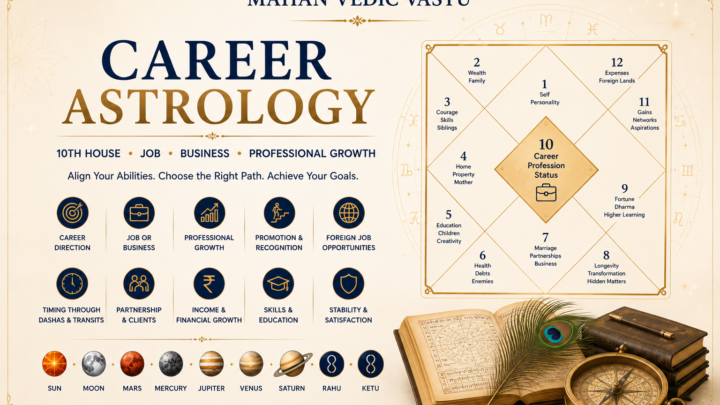
However, marriage astrology is not determined by the 7th house alone.
A meaningful analysis requires the astrologer to study the 7th house, its lord, planets influencing the 7th house and 7th lord, Venus, Jupiter, relevant divisional-chart indications, planetary periods and current transits together.
This combined approach provides a much stronger picture than interpreting one planet or one house in isolation.
What Is Marriage Astrology?
Marriage astrology is the study of planetary combinations connected with marriage, spouse, partnership and married life in a person’s horoscope.
The 7th house is the primary house of marriage and partnership, but it forms only one part of the analysis.
A detailed marriage reading may examine:
- the 7th house;
- the lord of the 7th house;
- planets occupying or aspecting the 7th house;
- condition and placement of the 7th lord;
- Venus and Jupiter;
- relationship between the Lagna, Lagna lord and 7th house;
- Navamsa or D9 chart;
- Vimshottari Dasha and relevant planetary periods;
- major transits;
- combinations associated with delay, conflict or separation; and
- compatibility between two horoscopes.
The strength of marriage analysis comes from connecting these factors, rather than drawing a conclusion from one placement.
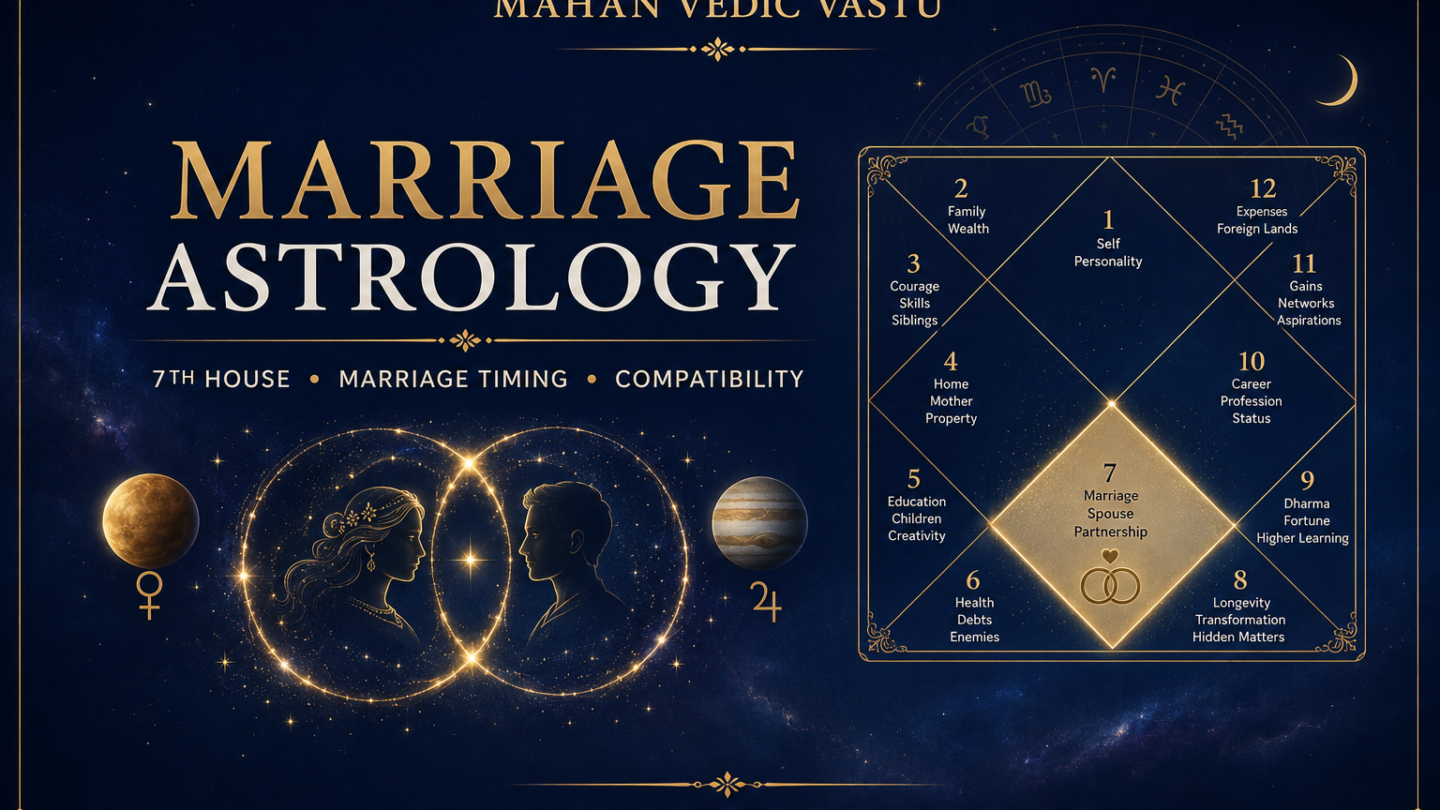
Why Is the 7th House Important for Marriage?
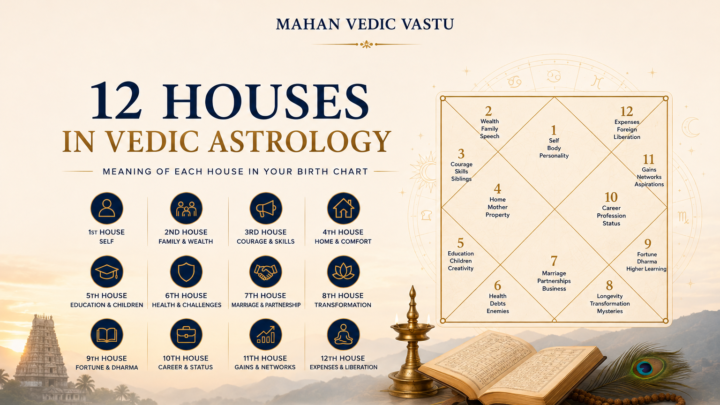
In Vedic astrology, the 7th house lies directly opposite the Ascendant or Lagna.
While the 1st house represents the self, the 7th house represents the other person with whom the native forms an important partnership.
Therefore, the 7th house is associated with:
- marriage;
- spouse;
- committed relationships;
- partnerships;
- agreements;
- interaction with others;
- business partnerships; and
- the way a person participates in one-to-one relationships.
For marriage analysis, we first identify the zodiac sign occupying the 7th house and its planetary lord.
We then examine where that 7th lord is positioned in the horoscope.
That placement can significantly change the interpretation.
Why the 7th Lord Matters
The 7th lord connects the marriage house with whichever house it occupies.
For example, when the 7th lord has a meaningful relationship with houses connected with family, romance, career, gains, travel or other areas of life, marriage may become connected with those themes.
But simply saying:
“Your 7th lord is in this house, therefore this exact event will happen”
is not a sufficiently complete interpretation.
The astrologer must also evaluate:
- dignity and strength of the 7th lord;
- conjunctions;
- aspects;
- functional lordship;
- benefic and challenging influences;
- condition of the receiving house;
- relevant planetary periods; and
- supporting indications elsewhere in the horoscope.
This is why two people with apparently similar 7th-house placements can experience marriage very differently.
Which Planets Are Important for Marriage Astrology?
Several planets can influence marriage, depending on the complete birth chart.
Venus and Marriage
Venus is strongly associated with attraction, affection, harmony, pleasure, relationship values and the ability to experience closeness.
Its sign, house placement, strength, conjunctions and aspects can provide important information about a person’s relationship tendencies.
A strong Venus does not automatically guarantee a perfect marriage, nor does a challenged Venus automatically mean an unhappy marriage.
The entire horoscope must support the conclusion.
Jupiter and Marriage
Jupiter represents wisdom, growth, values, guidance, expansion and dharma.
Its relationship with marriage-related houses and planets can contribute significantly to the overall quality of a marriage analysis.
Jupiter’s influence can also become particularly relevant when studying supportive periods and broader family development.
Saturn and Marriage
Saturn is frequently associated with delay, responsibility, discipline, maturity and long-term commitments.
Because of this, people sometimes become worried when Saturn influences the 7th house.
That conclusion is too simplistic.
Saturn may sometimes contribute to delay or a more serious approach to partnership, but its actual result depends upon:
- house lordship;
- sign placement;
- strength;
- aspects;
- conjunctions;
- Dasha;
- and the rest of the horoscope.
In some charts, Saturn can support endurance and commitment when appropriately placed.
Mars and Marriage
Mars represents energy, courage, action, passion, competitiveness and assertion.
Its relationship with marriage houses needs careful interpretation.
Strong or challenging Mars influences can sometimes indicate intensity, impatience or conflict, but conclusions should never be drawn solely from the presence of Mars in a particular house.
The complete chart must be evaluated.
Rahu and Ketu
Rahu and Ketu can introduce unusual, karmic, unconventional or highly transformative themes depending on their placements and planetary connections.
Their influence on the 1st–7th axis, 7th lord or marriage significators deserves special attention.
Again, neither node should automatically be labelled entirely positive or negative.
How Is Marriage Timing Predicted in Vedic Astrology?
One of the most frequently asked questions in an astrology consultation is:
“When will I get married?”
Marriage timing should not normally be predicted using a single transit.
The first step is to determine whether the natal horoscope contains supportive marriage indications.
The astrologer then examines the periods during which those indications can become active.
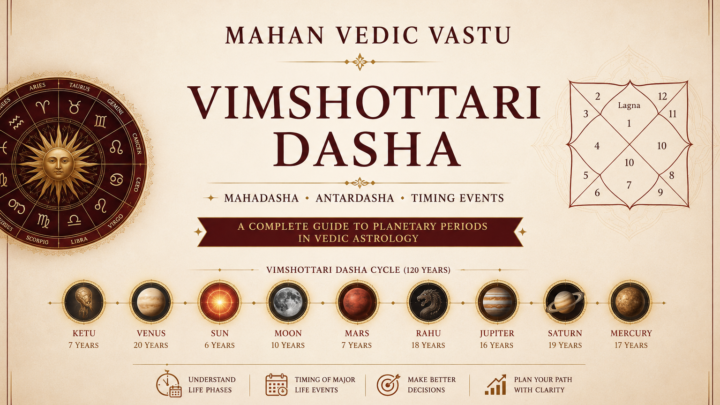
Vimshottari Dasha and Marriage Timing
Vimshottari Dasha is one of the major timing systems used in Vedic astrology.
Marriage may become more likely during the Dasha or Antardasha of planets connected with:
- the 7th house;
- 7th lord;
- Venus;
- Jupiter;
- Lagna or Lagna lord;
- relevant relationship houses;
- or planets strongly connected with marriage combinations.
The Dasha identifies the planetary period operating in the person’s life.
But Dasha alone is not enough.
Role of Transits in Marriage Timing
Transits can help identify periods when natal marriage indications receive additional activation.
The movements of Jupiter and Saturn are often studied carefully, together with other relevant planetary transits.
A strong analysis therefore looks for agreement between:
Natal Promise + Dasha/Antardasha + Transit Support
When several independent factors point toward the same period, the timing becomes more meaningful than a prediction based on one isolated transit.
What Can Cause Delay in Marriage According to Astrology?
Delayed marriage is another common reason people seek an astrology consultation.
Potential delay should never be judged from one placement alone.
An astrologer may investigate:
- condition of the 7th house;
- strength of the 7th lord;
- Saturn’s influence;
- Rahu–Ketu connections;
- challenging planetary associations;
- condition of Venus;
- relevant Navamsa indications;
- Dasha sequence; and
- whether the appropriate marriage period has actually become active.
Delay does not automatically mean denial.
Sometimes the horoscope indicates that partnership becomes more stable after greater maturity, career development, relocation or another major life transition.
Therefore, the question should not simply be:
“Is my marriage delayed?”
A better analysis asks:
Why might marriage be delayed, what factors are operating, and when do stronger supportive periods emerge?
Love Marriage or Arranged Marriage in Astrology
Another popular question is whether the horoscope indicates love marriage or arranged marriage.
Love and marriage are not represented by exactly the same astrological factors.
The 5th house is commonly associated with romance, attraction and emotional involvement, while the 7th house represents committed partnership and marriage.
Therefore, astrologers may study connections between:
- 5th house and 7th house;
- 5th lord and 7th lord;
- Venus;
- Lagna and Lagna lord;
- Rahu and other relevant planets;
- Dasha activation; and
- supporting indications in divisional charts.
Strong connections can indicate that romance and marriage become closely related.
But one combination should not be treated as an absolute rule.
What Does Astrology Say About Your Future Spouse?
Marriage astrology can also be used to study broad characteristics associated with the spouse.
The analysis may consider:
- sign occupying the 7th house;
- 7th lord;
- planets in the 7th house;
- aspects to the 7th;
- planetary strength;
- Navamsa;
- and other connected factors.
These may provide indications concerning temperament, communication style, values, professional tendencies or the overall nature of partnership.
Astrology is better used to identify patterns and tendencies than to construct an unrealistic exact description of a future person.
Navamsa D9 Chart and Marriage
The Navamsa chart (D9) is one of the most important divisional charts used in Vedic astrology.
It provides an additional layer of interpretation concerning planetary strength, dharma and marriage.
However, a common mistake is to analyse the Navamsa completely independently of the birth chart.
The D1 birth chart remains fundamental.
The Navamsa should be used to deepen and refine the interpretation of the natal horoscope, not replace it.
For marriage analysis, we may compare:
- D1 7th house indications;
- D1 7th lord;
- Venus and Jupiter;
- D9 Lagna;
- D9 7th house and lord;
- planetary strength in Navamsa;
- and repeating patterns between D1 and D9.
Repeated indications deserve greater attention.
Marriage Compatibility in Vedic Astrology
Marriage compatibility involves much more than deciding whether two zodiac signs match.
Two individuals bring different:
- emotional patterns;
- expectations;
- communication styles;
- family backgrounds;
- temperaments;
- planetary periods; and
- life directions
into a relationship.
Traditional horoscope matching can form part of the process, but a deeper compatibility analysis should examine both horoscopes individually before comparing them.
This is important because a relationship may appear compatible according to one matching method while important individual chart factors tell a more complicated story.
A structured compatibility analysis therefore asks three questions:
What does Person A need from a relationship?
What does Person B need from a relationship?
How do their planetary patterns interact?
That produces a more useful interpretation than relying only on a compatibility score.
Can Astrology Predict Divorce or Separation?
Certain planetary combinations may indicate periods of relationship stress, disagreement, emotional distance or major transformation.
However, declaring divorce from one planetary placement is inappropriate.
A responsible analysis should examine:
- both partners’ charts where possible;
- strength of marriage houses;
- Dasha and Antardasha;
- transits;
- repeated patterns;
- duration of challenging periods; and
- constructive planetary influences capable of supporting reconciliation or maturity.
Astrology can identify periods that may require greater awareness.
Human decisions, communication, circumstances and behaviour remain extremely important.
Common Mistakes in Marriage Astrology
Several oversimplifications are repeatedly seen in marriage predictions:
- judging marriage only from the 7th house;
- assuming Saturn always denies marriage;
- assuming Mars automatically destroys marriage;
- predicting marriage from Jupiter transit alone;
- interpreting Rahu or Ketu as automatically negative;
- reading Navamsa without connecting it to the birth chart;
- predicting divorce from one combination;
- using only zodiac-sign compatibility;
- promising an exact marriage date without sufficient supporting factors.
Vedic astrology becomes much more meaningful when multiple independent indicators are studied together.
How Mahan Vedic Vastu Approaches Marriage Astrology
At Mahan Vedic Vastu, marriage analysis is approached as an interconnected study rather than a single-house prediction.
The objective is to understand the relationship between the natal chart, functional planetary roles, marriage houses, planetary associations, divisional-chart indications, Dashas and transits.
If you need a personalised examination of marriage timing, relationship patterns or spouse-related indications, you can choose an Astrology consultation based on your complete birth details.
For students who want to understand how houses, planets, aspects, Dashas and chart connections are interpreted systematically, the Mahan Vedic Vastu Astrology Course provides a structured learning pathway.
For individual guidance based on your horoscope rather than general online information, you can book a personal consultation.
Frequently Asked Questions
Which house represents marriage in Vedic astrology?
The 7th house is the principal house associated with marriage, spouse and committed partnership. However, the 7th lord, planetary influences, marriage significators, Navamsa, Dashas and transits should also be studied.
Which planet is responsible for marriage?
There is no single planet that independently controls every person’s marriage. Venus and Jupiter are important marriage significators, while the 7th lord and planets connected with the 7th house play major roles according to the individual horoscope.
Can the 7th house predict marriage age?
The 7th house provides information about marriage, but marriage timing requires additional analysis. Dasha–Antardasha periods, planetary connections, Navamsa and relevant transits are normally considered together.
Does Saturn in the 7th house delay marriage?
Saturn can sometimes be associated with delay, maturity or greater responsibility in partnership, but Saturn in the 7th house does not automatically mean delayed or unhappy marriage. Its lordship, dignity, aspects and complete chart context must be evaluated.
Can astrology predict love marriage?
Connections between romance-related factors, particularly the 5th house, and marriage-related factors such as the 7th house may support a love-marriage interpretation. Other planetary combinations and timing factors must confirm the pattern.
What is the role of Navamsa in marriage astrology?
The Navamsa or D9 chart is an important divisional chart for studying marriage and planetary strength. It should be interpreted together with the main D1 birth chart rather than in isolation.
Can astrology accurately predict the exact date of marriage?
Astrology can be used to identify stronger and weaker periods for marriage through the combined study of the natal horoscope, Dashas and transits. Claiming an exact date without sufficient supporting indications can create false precision.
Can horoscope matching guarantee a successful marriage?
No compatibility method can guarantee the outcome of a marriage. Compatibility analysis can highlight areas of harmony, difference and potential challenge, while the actual relationship also depends upon communication, maturity, choices and circumstances.
Marriage astrology is most useful when the horoscope is treated as an interconnected system rather than reducing a person’s future to one house, planet or combination. The 7th house provides the foundation, while its lord, planetary influences, Navamsa, Dashas and transits add the layers necessary for a more complete interpretation.
Editorial note: This article presents Vedic astrology as a traditional interpretive system for education and self-reflection. Individual circumstances and outcomes can vary, and important relationship or marriage decisions should not be based solely on astrological interpretation.