A birth chart analysis in Vedic Astrology involves much more than identifying your zodiac sign or reading a general daily horoscope.
Your birth chart—commonly called a Kundli, Kundali or Janma Kundli—is a symbolic map of the planetary positions calculated for the date, time and place of your birth.
It contains multiple interconnected layers.
The Ascendant or Lagna establishes the house structure. The twelve houses represent different areas of life. The nine Grahas occupy particular signs and houses. Nakshatras provide another level of interpretation. Planetary aspects and conjunctions modify relationships between different parts of the chart, while Dashas and transits help astrologers study timing.
For this reason, meaningful Vedic Astrology does not normally interpret one planet, one house or one yoga in isolation.
The chart needs to be read as an integrated system.
This guide explains the major components of a Vedic birth chart and how they work together in a structured horoscope analysis.
What Is a Birth Chart in Vedic Astrology?
A birth chart is a representation of the sky calculated for the time and location of a person’s birth.
In Vedic Astrology, it is commonly known as the Janma Kundli, Janma Kundali, horoscope or natal chart.
The chart is divided into twelve houses, and the planets are placed according to their astronomical positions at the time of birth.
Three pieces of information are therefore especially important:
- date of birth
- exact time of birth
- place of birth
These details are used to calculate the Ascendant and the planetary positions.
Even people born on the same calendar date may have different charts because the time and place of birth can alter the Ascendant, house positions and other chart factors.
Why Is the Exact Birth Time Important?
Birth time is particularly important because the Ascendant or Lagna changes throughout the day.
A relatively small difference in recorded birth time can sometimes affect the rising degree and, near a boundary, potentially change the Ascendant or other time-sensitive chart factors.
Birth time can also influence divisional charts and the precise placement used in deeper analysis.
This is why an astrologer should not treat an uncertain birth time as though it were unquestionably exact.
Where the recorded time is doubtful, the limitation should be recognised before making highly specific interpretations.
What Is the Lagna or Ascendant?
The Lagna, also known as the Ascendant, is the zodiac sign rising on the eastern horizon at the time and place of birth.
It establishes the first house of the horoscope.
From the Lagna, the remaining houses are arranged in sequence.
The Ascendant is important because it provides a primary reference point for interpreting the chart, including:
- physical orientation and self-expression
- temperament
- general approach to life
- house structure
- functional roles of planets
- relationships between houses and their lords
The Lagna should not be interpreted by sign alone.
Its lord, planetary occupants, aspects, strength and relationships with other chart factors also matter.
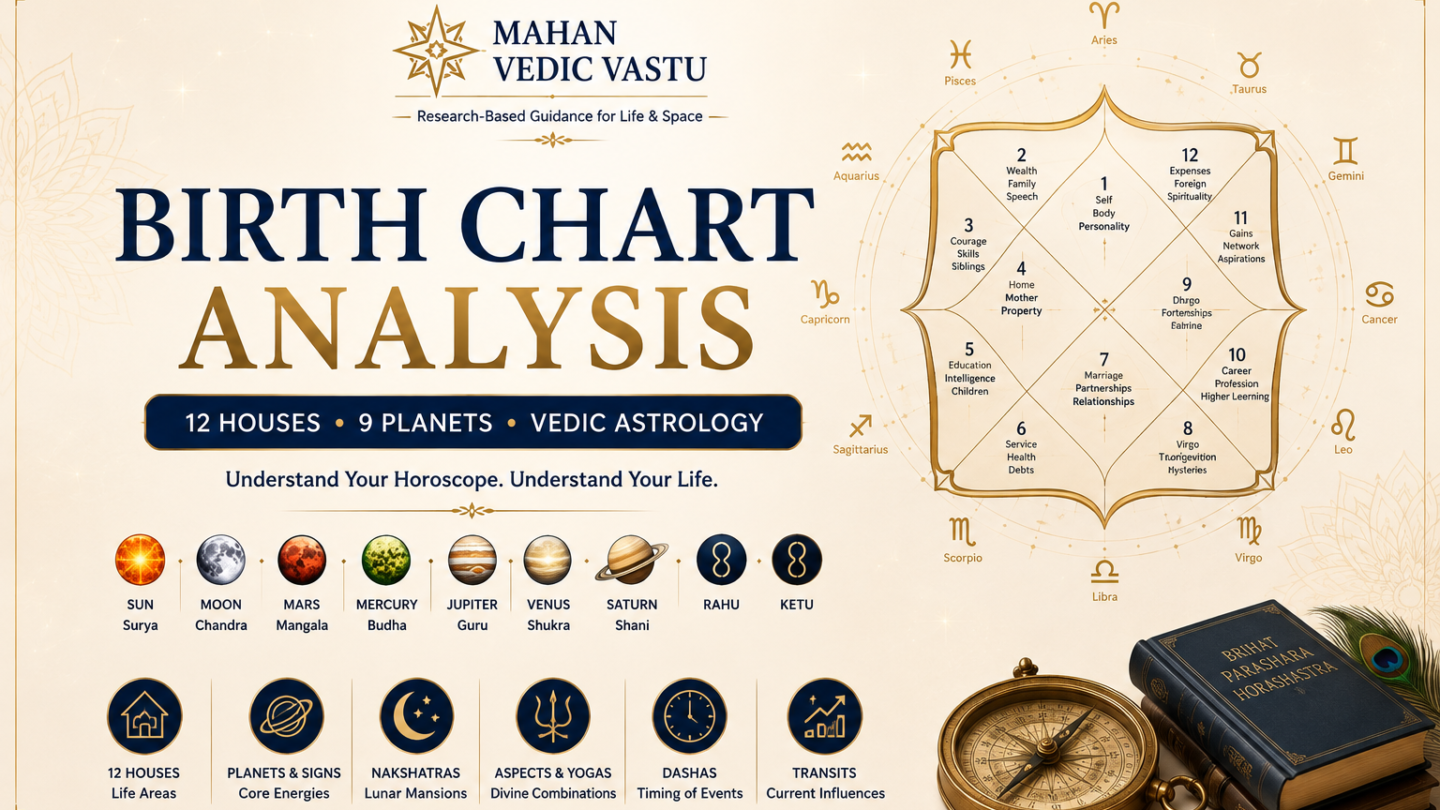
What Are the 12 Houses in Vedic Astrology?
The birth chart is divided into 12 houses, known as Bhavas.
Each house represents a field of life experience.
| House | Broad Areas Commonly Studied |
|---|---|
| 1st House | Self, body, personality, general life orientation |
| 2nd House | Family, speech, accumulated resources, values |
| 3rd House | Courage, communication, skills, effort, siblings |
| 4th House | Home, mother, property, emotional foundation |
| 5th House | Intelligence, education, creativity, children |
| 6th House | Challenges, competition, service, debts, disputes |
| 7th House | Marriage, partnership, agreements, public dealings |
| 8th House | Transformation, longevity, inheritance, hidden matters |
| 9th House | Dharma, higher learning, fortune, teachers, beliefs |
| 10th House | Career, profession, actions, responsibility, status |
| 11th House | Gains, networks, aspirations, fulfilment |
| 12th House | Expenditure, withdrawal, foreign connections, liberation |
These are broad significations rather than complete definitions.
Every house can represent several interconnected themes.
Why Should a House Never Be Read Alone?
Suppose someone wants to understand career.
It may be tempting to look only at the 10th house.
But a professional analysis may also examine:
- 10th house
- 10th lord
- planets occupying the 10th
- aspects influencing the 10th
- Lagna and Lagna lord
- relevant supporting houses
- planetary strength
- Dashas
- divisional charts
- current transits
Similarly, marriage should not be predicted merely by seeing one planet in the 7th house.
The complete relationship between the relevant houses, lords, significators and timing factors should be considered.
This principle applies throughout birth chart analysis.
What Are the 9 Planets in Vedic Astrology?
Vedic Astrology traditionally works with the Navagrahas, or nine Grahas:
- Sun — Surya
- Moon — Chandra
- Mars — Mangala
- Mercury — Budha
- Jupiter — Guru or Brihaspati
- Venus — Shukra
- Saturn — Shani
- Rahu
- Ketu
Rahu and Ketu are not physical planets. They are the lunar nodes used in astrological calculations.
Each Graha has its own natural significations, but its actual expression in a horoscope depends on several factors.
What Does the Sun Represent?
The Sun is traditionally associated with themes such as identity, authority, vitality, leadership, recognition and father-related significations.
However, the Sun should not automatically be labelled positive or negative.
Its sign, house, lordship, strength, aspects, conjunctions and relationship with the rest of the horoscope influence how it is interpreted.
What Does the Moon Represent?
The Moon is closely associated with the mind, emotional responses, habits, receptivity, nurturing and subjective experience.
Its sign and Nakshatra are particularly important in many areas of Vedic Astrology.
The Moon also plays an important role in several timing and interpretive systems.
What Does Mars Represent?
Mars is traditionally associated with action, courage, initiative, competition, physical drive and the ability to confront challenges.
Its constructive expression can support decisiveness and disciplined effort.
When poorly integrated, the same force may be expressed through impatience, conflict or excessive impulsiveness.
Context determines interpretation.
What Does Mercury Represent?
Mercury is associated with communication, analysis, learning, reasoning, calculation, trade and adaptability.
Its behaviour can be strongly influenced by its sign, house and association with other planets.
This is why Mercury should not be interpreted merely from its natural significations.
What Does Jupiter Represent?
Jupiter is traditionally connected with wisdom, expansion, learning, teachers, judgement, principles and guidance.
It is generally classified as a natural benefic, but this does not mean that every Jupiter placement automatically produces identical positive results.
House ownership, strength, aspects, conjunctions and the complete chart must still be considered.
What Does Venus Represent?
Venus is associated with relationships, attraction, comfort, aesthetics, enjoyment, harmony and artistic expression.
In relationship analysis, Venus may be important, but it should not replace the study of the 7th house, its lord, other relevant significators and the complete horoscope.
What Does Saturn Represent?
Saturn is associated with discipline, responsibility, endurance, delay, structure, work and long-term development.
Saturn is sometimes feared because of its association with restriction and difficulty.
A more balanced interpretation considers both sides.
The same Saturn that creates delay may also encourage patience, realism, responsibility and durable achievement.
What Are Rahu and Ketu?
Rahu and Ketu are the two lunar nodes.
They always occupy opposite points in the zodiac and form an axis in the birth chart.
Rahu is often associated with amplification, desire, worldly experience, unfamiliar territory and unconventional development.
Ketu is commonly associated with detachment, separation, internalisation and areas where conventional satisfaction may be reduced.
Because they operate as an axis, Rahu and Ketu are often more meaningful when interpreted together rather than independently.
What Are Zodiac Signs or Rashis?
The zodiac is divided into twelve signs or Rashis.
They are:
- Aries — Mesha
- Taurus — Vrishabha
- Gemini — Mithuna
- Cancer — Karka
- Leo — Simha
- Virgo — Kanya
- Libra — Tula
- Scorpio — Vrischika
- Sagittarius — Dhanu
- Capricorn — Makara
- Aquarius — Kumbha
- Pisces — Meena
A useful distinction for beginners is:
Houses describe areas of life.
Signs describe the qualities or manner through which planetary energies may operate.
Planets represent active significators and functions within the horoscope.
Interpretation comes from studying how these three layers interact.
What Are House Lords in Astrology?
Every zodiac sign has a planetary ruler.
When a particular sign occupies a house, the ruler of that sign becomes the lord of that house.
This creates connections between different areas of the horoscope.
For example, if the lord of one house occupies another house, the themes represented by those houses may become linked.
This is one reason birth chart analysis cannot be reduced to a simple list of planet meanings.
The network of house lordships is fundamental to interpretation.
What Are Planetary Aspects?
An aspect describes the influence or relationship a planet forms with another part of the horoscope according to the astrological system being used.
Aspects can connect planets with houses or other planets.
Therefore, an apparently empty house is not necessarily astrologically inactive.
Its lord, aspects and other relationships may still make it important.
What Is a Planetary Conjunction?
When two or more planets occupy the same sign or house region, they may form a conjunction.
A conjunction combines planetary influences, but its meaning cannot be determined simply by adding two keywords together.
Interpretation may depend on:
- the planets involved
- their functional roles
- sign placement
- degree proximity
- relative strength
- house involved
- aspects
- relevant Dashas
Some conjunctions can support one another; others may create tension or complexity.
What Are Nakshatras?
Vedic Astrology divides the zodiac into 27 Nakshatras, commonly known as lunar mansions.
Each Nakshatra covers 13°20′ of the zodiac and is divided into four Padas.
Nakshatras provide another layer of detail beyond the twelve zodiac signs.
The Moon’s Nakshatra is particularly significant in several Vedic Astrology traditions and is connected with important timing systems such as Vimshottari Dasha.
However, Nakshatras can also be considered for other planets depending on the method of analysis.
What Are Yogas in Vedic Astrology?
A Yoga is a specific planetary relationship or configuration described in astrological tradition.
There are many categories of Yogas relating to different themes.
A common mistake is to discover one famous Yoga in a chart and immediately assume that its textbook result must occur.
In practice, an astrologer should examine factors such as:
- whether the Yoga is genuinely formed
- planetary strength
- house placement
- functional lordship
- supporting or conflicting influences
- relevant planetary periods
- overall chart context
The existence of a Yoga alone should not be treated as a guaranteed life outcome.
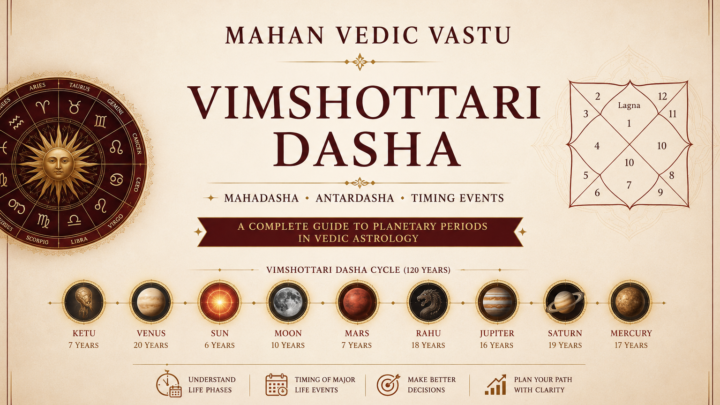
What Is Vimshottari Dasha?
One of the important timing systems used in Vedic Astrology is Vimshottari Dasha.
It divides life into planetary periods.
The major period is called Mahadasha, with further subdivisions such as Antardasha.
The basic principle is that different planetary influences become especially relevant during their respective periods.
However, a Mahadasha should not be judged from the planet’s general meaning alone.
The planet’s natal placement, house lordship, strength, aspects, conjunctions and other chart relationships need to be studied first.
What Are Planetary Transits?
A birth chart represents planetary positions at birth.
The planets, however, continue moving.
Their ongoing movement through the zodiac is studied through transits, or Gochar.
Transits can be considered in relation to the natal chart and other reference points.
They are often used to understand periods of activation, pressure, opportunity or transition.
But transits should not normally replace natal analysis and Dasha timing.
A major transit may affect two people differently because their birth charts are different.
Dasha vs Transit: What Is the Difference?
A simple way to understand the distinction is:
The birth chart describes the natal framework.
Dasha identifies planetary periods operating within that framework.
Transits describe current planetary movement interacting with it.
A stronger timing analysis considers how these layers work together rather than relying on only one of them.
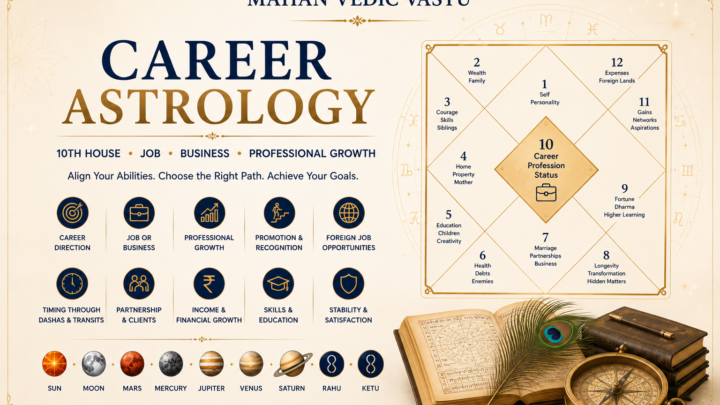
How Is Career Analysed in a Birth Chart?
Career analysis is one of the most common reasons people seek an astrology consultation.
A professional career reading may consider the 10th house and its lord, but it can also involve:
- Lagna and Lagna lord
- 2nd house
- 6th house
- 10th house
- 11th house
- planetary strengths
- relevant Yogas
- divisional charts
- Dashas
- current transits
The purpose is not merely to name one profession.
A useful analysis may explore natural strengths, work style, suitable professional environments, periods of development and possible areas requiring greater effort.
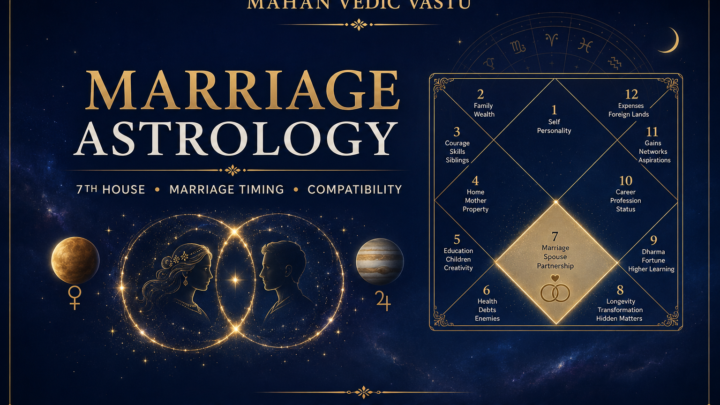
How Is Marriage Analysed in Vedic Astrology?
Marriage analysis requires more than checking whether Venus or Jupiter is strong.
Depending on the method and context, astrologers may consider:
- 7th house
- 7th lord
- relevant relationship significators
- Lagna
- planetary aspects
- conjunctions
- Navamsa or D9
- Dashas
- transits
Compatibility between two people also requires comparison rather than reading one chart in isolation.
Astrology should not be used to reduce a complex relationship to one frightening placement or a single compatibility score.
How Are Finance and Wealth Analysed?
Financial interpretation can involve several houses and planetary relationships.
Common areas studied include:
- income
- accumulated resources
- profession
- gains
- financial habits
- periods of expansion or restraint
The 2nd and 11th houses are often relevant, but financial analysis should not be limited to them.
Career, house lords, planetary strength, Dashas and other combinations may modify the picture considerably.
Astrological interpretation should also not replace qualified financial advice when making investment or other financial decisions.
How Is Education Analysed?
Education can be studied through several factors, including houses associated with learning, intelligence, higher knowledge and skill development.
Mercury and Jupiter may also be relevant depending on the question.
A good educational reading should not simply declare that someone is “good” or “bad” at studies.
Different charts may suggest different styles of learning, areas of aptitude, periods of concentration, interruptions or specialised interests.
How Are Children and Family Analysed?
Family-related analysis can involve several houses because “family” is not represented by only one factor.
The 2nd, 4th, 5th and other relevant houses may become important depending on the question.
For matters relating specifically to children, the 5th house and its lord are commonly examined along with appropriate supporting factors and timing systems.
Can a Birth Chart Predict Health?
Astrology may traditionally be used to discuss constitutional tendencies, periods requiring care or symbolic patterns associated with health.
However, a birth chart should never replace medical diagnosis, testing or treatment.
Astrological observations about health should be treated cautiously and responsibly.
Anyone experiencing symptoms or health concerns should consult a qualified medical professional.
Can Astrology Indicate Foreign Travel or Settlement?
Foreign travel or residence is another common consultation question.
A proper analysis may consider several houses, planetary relationships, Dashas and transits rather than relying on one placement.
There is also an important distinction between:
- short travel
- long-distance travel
- temporary residence
- professional relocation
- education abroad
- permanent settlement
These should not automatically be treated as the same question.
Are Benefic Planets Always Good and Malefic Planets Always Bad?
No.
Traditional astrology describes certain planets as natural benefics or natural malefics, but that classification is only one layer of interpretation.
Functional lordship, house placement, sign strength, aspects, conjunctions and the overall horoscope can substantially modify results.
Saturn, for example, can represent pressure and delay but also discipline and endurance.
Mars can represent conflict but also courage and decisive action.
A responsible analysis avoids simplistic labels.
Why Online Birth Chart Calculators and Astrology Readings Can Differ
Two astrology websites may display or interpret a chart differently because of differences in:
- zodiac settings
- Ayanamsa
- house or chart conventions
- birth-time handling
- calculation software
- interpretive methodology
Even when the planetary calculations agree, automated interpretations may differ because interpretation requires prioritising multiple chart factors.
An automatically generated description of one planet in one house cannot fully represent the entire horoscope.
Common Birth Chart Interpretation Mistakes
One of the biggest mistakes is making a major conclusion from one placement.
Other common errors include:
- reading only the Sun sign
- judging only the Moon sign
- ignoring the Ascendant
- treating one house as the complete answer
- assuming every conjunction gives the same result
- declaring a Yoga without checking its strength
- interpreting a Mahadasha without studying the natal planet
- relying only on transits
- treating Rahu or Ketu as automatically negative
- fearing Saturn without analysing its actual role
- making marriage predictions from one placement
- making career predictions only from the 10th house
- ignoring divisional charts when deeper analysis requires them
- treating uncertain birth time as exact
The strength of Vedic Astrology lies in synthesis.
How a Professional Birth Chart Analysis Is Different
An automated horoscope can be useful for calculating planetary positions and learning basic terminology.
Professional interpretation serves a different purpose.
Instead of reading each factor independently, the astrologer attempts to understand how the chart works as a whole.
For example, a professional analysis may ask:
What is the condition of the Lagna?
Which houses are strongly activated?
How do the house lords connect?
Which planetary themes repeat?
Are apparent strengths supported elsewhere?
Which Dasha is currently operating?
What do current transits activate?
Which conclusions are strongly supported, and which remain uncertain?
This process is closer to structured synthesis than to reading a list of isolated predictions.
For an individual interpretation of your horoscope, planetary periods and important life areas, you can explore our Astrology Consultation.
Birth Chart Analysis Should Consider the Complete Person
A horoscope is not a substitute for the person living the life.
Two individuals with superficially similar placements may make different choices, grow in different environments and express the same astrological symbolism differently.
Birth chart analysis is therefore most useful when it combines technical interpretation with real-life context.
Rather than asking only:
“What will happen to me?”
more useful questions can include:
“What patterns are strongly indicated?”
“Which periods deserve attention?”
“Where are my natural strengths?”
“Which areas require conscious development?”
This produces a more balanced and practical approach to astrology.
Learn Vedic Astrology Systematically
A single article can introduce the components of a horoscope, but learning to interpret them requires structured study.
A student eventually needs to understand how Lagna, houses, house lords, planets, Rashis, Nakshatras, aspects, conjunctions, Yogas, divisional charts, Dashas and transits interact.
Memorising hundreds of isolated meanings is not enough.
The goal is to develop the ability to synthesise the chart.
If you want to learn these principles through a structured pathway, explore the Mahan Vedic Vastu Astrology Course.
When Should You Consider an Astrology Consultation?
General astrology articles are useful for education.
Personal analysis becomes more relevant when the question concerns your own chart and circumstances.
You may consider an individual consultation for areas such as:
- complete birth chart analysis
- career and profession
- business
- marriage
- love and relationships
- education
- children and family
- financial patterns
- foreign settlement
- important life periods
- Muhurta
- personal guidance
A consultation can examine several interacting factors rather than trying to answer an important life question from one planetary placement.
For personalised analysis of your birth chart, planetary periods and relevant life areas, you can Book a Consultation.
Frequently Asked Questions
What is a birth chart in Vedic Astrology?
A birth chart, Kundli or Janma Kundli is a horoscope calculated from the date, time and place of birth. It shows the Ascendant and planetary positions used for astrological interpretation.
Is Kundli the same as a birth chart?
In common usage, yes. Kundli, Kundali, Janma Kundli, natal chart and birth chart are terms used for the horoscope constructed for the time of birth, although terminology can vary between traditions.
What are the 12 houses in a birth chart?
The twelve houses represent different areas of life, including self, family, communication, home, education, children, challenges, marriage, transformation, higher learning, career, gains and withdrawal or foreign-related themes.
What are the 9 planets in Vedic Astrology?
The Navagrahas are Sun, Moon, Mars, Mercury, Jupiter, Venus, Saturn, Rahu and Ketu. Rahu and Ketu are lunar nodes rather than physical planets.
What is Lagna in a Kundli?
Lagna or Ascendant is the zodiac sign rising on the eastern horizon at the person’s birth time and location. It establishes the first house and is a major reference point for chart interpretation.
Which is more important: Moon sign or Lagna?
They serve different interpretive purposes. Lagna provides the primary house framework, while the Moon is important for mind, emotional experience and several timing and interpretive techniques. A complete reading considers both along with the rest of the chart.
What is a Nakshatra?
A Nakshatra is one of the 27 lunar mansions used in Vedic Astrology. Each spans 13°20′ of the zodiac and contains four Padas.
What is Mahadasha?
Mahadasha is a major planetary period within a Dasha system such as Vimshottari Dasha. Its interpretation depends on the condition and role of the Mahadasha planet in the natal horoscope.
Can two people born on the same day have different Kundlis?
Yes. Different birth times or locations can produce different Ascendants, house structures and other chart factors.
Can an online Kundli predict my future accurately?
Online tools can calculate charts and provide general interpretations, but automated descriptions often analyse factors independently. Personal horoscope interpretation normally requires synthesis of multiple chart factors and appropriate timing techniques.
Can Vedic Astrology predict the exact date of an event?
Astrological timing techniques may be used to identify periods associated with particular themes or possibilities, but responsible interpretation should avoid presenting uncertain future outcomes as guaranteed facts.
What if my birth time is not accurate?
Birth-time uncertainty can affect the Ascendant, house positions and other time-sensitive calculations. The degree of uncertainty should therefore be recognised before making highly specific interpretations.
Final Thoughts
A birth chart analysis is not simply a collection of twelve houses and nine planets.
It is the study of relationships.
The Lagna establishes the framework. Houses describe different areas of life. Rashis provide the environment through which planetary qualities operate. Grahas connect different parts of the horoscope. Nakshatras add another level of detail. Yogas describe particular combinations, while Dashas and transits introduce timing.
No single factor tells the whole story.
The deeper skill in Vedic Astrology lies in learning which factors deserve priority, how apparently conflicting indications should be reconciled and how the entire horoscope relates to the individual’s actual circumstances.
That is the difference between simply reading a birth chart and learning to interpret one.
This article presents Vedic Astrology as a traditional interpretive system for education and self-reflection. Astrological interpretation should not replace qualified medical, legal, financial, psychological or other professional advice, and individual outcomes can be influenced by personal circumstances, choices and many factors beyond an astrological chart.