Lo Shu Grid is a numerology chart created from the numbers present in a person’s date of birth. It arranges the numbers 1 to 9 in a fixed 3×3 pattern and is traditionally used to study how frequently particular numerical qualities appear in the birth-date profile.
A Lo Shu Grid can immediately show which numbers are present, missing or repeated. It can also reveal specific number combinations commonly studied as planes and arrows.
However, seeing a missing number or repeated number should not lead to an instant positive or negative conclusion. A useful interpretation considers the complete grid, the Birth Number, Life Path Number and other relevant numerology factors together.
This guide explains how the Lo Shu Grid works, how to calculate it from a date of birth, and how Mahan Vedic Vastu approaches missing numbers, repeated numbers, planes and arrows without reducing the complete person to a single number.
What Is a Lo Shu Grid?
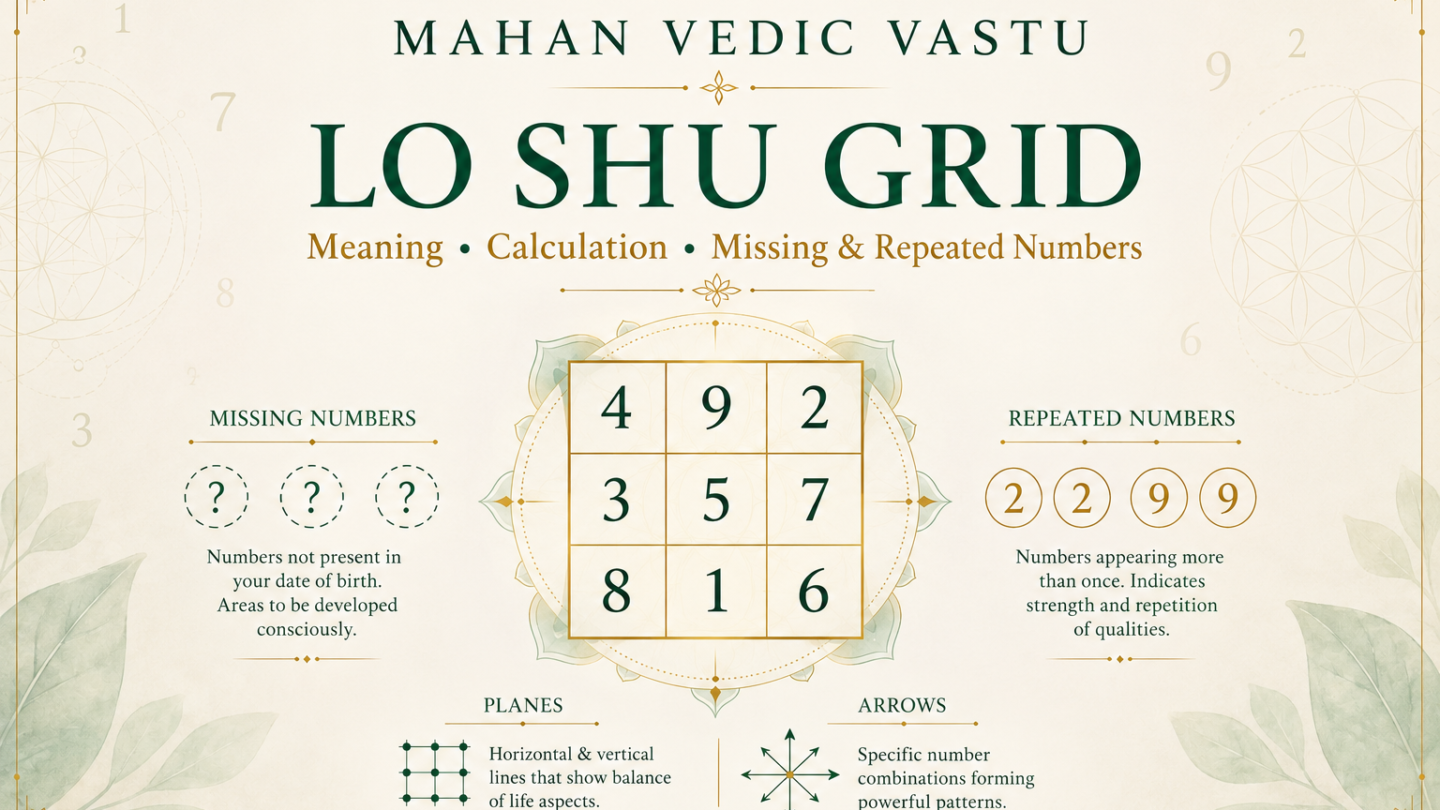
The Lo Shu Grid is a square containing nine positions arranged in three rows and three columns.
Each position corresponds to one number from 1 to 9.
The traditional arrangement is:
| 4 | 9 | 2 |
|---|---|---|
| 3 | 5 | 7 |
| 8 | 1 | 6 |
The positions do not change.
When a person’s date of birth is entered into the grid, each relevant digit is placed in its corresponding position.
If a number occurs more than once, it is repeated in that position. If a number does not occur in the date of birth, its position remains empty.
This simple arrangement forms the foundation for further Lo Shu Grid interpretation.
Lo Shu Grid Number Arrangement
For clarity, the fixed arrangement is:
Top row: 4 – 9 – 2
Middle row: 3 – 5 – 7
Bottom row: 8 – 1 – 6
This sequence should not be rearranged according to the person’s Birth Number or Life Path Number.
The grid remains fixed; the date of birth determines which numbers appear inside it.
That distinction is important when manually constructing a Lo Shu Grid.
How to Calculate a Lo Shu Grid From Date of Birth
A basic Lo Shu Grid calculation begins with the numerical digits in the date of birth.
For example, consider:
24 May 1992
Written numerically:
24-05-1992
The digits are:
2, 4, 0, 5, 1, 9, 9, 2
In standard Lo Shu Grid construction, 0 is not placed in the 1–9 grid.
The numbers entered are therefore:
1, 2, 2, 4, 5, 9, 9
Now place each digit in its fixed position.
The resulting pattern shows:
- 1 appears once
- 2 appears twice
- 4 appears once
- 5 appears once
- 9 appears twice
- 3 is missing
- 6 is missing
- 7 is missing
- 8 is missing
Immediately, the chart provides three types of information:
present numbers, repeated numbers and missing numbers.
What Do Present Numbers Mean in a Lo Shu Grid?
A present number is a number from 1 to 9 that occurs at least once in the date of birth and therefore appears in its corresponding Lo Shu Grid position.
Its presence indicates that the qualities traditionally associated with that numerical position are available within the birth-date pattern.
But presence alone does not tell the whole story.
The interpretation can change according to:
- whether the number appears once or repeatedly;
- which other numbers are present;
- which numbers are absent;
- whether particular planes or arrows are formed;
- the person’s Birth Number;
- the person’s Life Path Number; and
- other numerological factors being studied.
This is why a Lo Shu Grid should be interpreted as a pattern, rather than as nine isolated boxes.
Meaning of Numbers 1 to 9 in the Lo Shu Grid
Each number has a traditional interpretive role within the grid.
The following descriptions are intentionally concise. A personalised analysis requires the complete numerical pattern.
Number 1 in Lo Shu Grid
Number 1 is commonly associated with individual expression, initiative and communication of the self.
Its expression can vary depending on repetition and surrounding numbers.
Number 2 in Lo Shu Grid
Number 2 is associated with sensitivity, receptivity, cooperation and emotional awareness.
Its strength should be interpreted in relation to the complete chart.
Number 3 in Lo Shu Grid
Number 3 relates to expression, imagination, learning and the ability to communicate ideas.
Presence or absence does not independently determine intelligence or success.
Number 4 in Lo Shu Grid
Number 4 is connected with order, practicality, structure and methodical effort.
Its role becomes clearer when examined alongside the other practical and mental indicators in the grid.
Number 5 in Lo Shu Grid
Number 5 occupies the central position of the Lo Shu Grid.
It is often associated with balance, adaptability, experience and the way different qualities interact.
Because of its central position, it deserves careful interpretation rather than a simple positive or negative label.
Number 6 in Lo Shu Grid
Number 6 is commonly associated with responsibility, relationships, family considerations and practical care.
Its expression can differ significantly depending on the rest of the grid.
Number 7 in Lo Shu Grid
Number 7 is traditionally connected with reflection, learning through experience, analysis and deeper understanding.
It should not automatically be interpreted as either spiritual or difficult.
Number 8 in Lo Shu Grid
Number 8 can relate to organisation, discipline, material responsibility and practical management.
Its expression depends on repetition and its connections with other positions.
Number 9 in Lo Shu Grid
Number 9 is commonly associated with idealism, broader thinking, intensity and humanitarian awareness.
As with every Lo Shu number, the complete pattern determines how these qualities may be expressed.
What Are Missing Numbers in a Lo Shu Grid?
A missing number in the Lo Shu Grid is simply a number from 1 to 9 that does not occur in the person’s date of birth.
Its corresponding grid position therefore remains empty.
For example, if a date of birth contains no digit 6, the number 6 position will be empty.
Missing numbers are often interpreted as areas where particular qualities may require greater conscious development, experience or practical attention.
However, this should not become:
“Missing number = bad luck.”
That is an oversimplification.
A missing number may interact with present numbers, repeated numbers, planes, arrows and the person’s wider numerology profile.
The constructive question is therefore not:
“Which numbers are bad because they are missing?”
It is:
“What can this pattern teach us about qualities that may need conscious development?”
Are Missing Numbers in Lo Shu Grid Bad?
No. A missing number should not automatically be classified as negative.
Almost everyone has some numbers absent from their birth-date grid.
A missing position can instead be approached as an area where certain qualities may be developed through awareness, environment, education, experience and deliberate choices.
For example, two people may both have the same missing number but handle the associated life situations very differently.
Their Birth Numbers, Life Path Numbers, repeated numbers and complete grid patterns may not be the same.
Therefore, missing-number interpretation should remain constructive rather than fear-based.
What Are Repeated Numbers in a Lo Shu Grid?
A repeated number occurs when the same digit appears two or more times in the date of birth.
For example:
If the number 2 appears twice, it is represented as:
22
If it appears three times:
222
Repetition generally increases the emphasis of the qualities associated with that numerical position.
But more is not automatically better.
A quality that is naturally strong may become a useful strength when expressed constructively. The same quality can become excessive when it dominates the pattern without sufficient balance.
Therefore:
Repeated number ≠ automatically lucky
and
Missing number ≠ automatically unlucky.
The important factor is balance and interaction within the complete grid.
What Does It Mean When a Number Appears Three or More Times?
Multiple repetitions deserve additional attention.
If a particular digit appears three or more times, the qualities associated with that position may become especially prominent.
This can produce:
- a naturally strong tendency;
- greater familiarity with a particular mode of behaviour;
- an ability that develops easily;
- or, in some cases, over-expression of that same quality.
For this reason, MVV interpretation does not simply count repetitions and label them “powerful.”
The question is whether that numerical emphasis is being expressed constructively, excessively or in balance with the rest of the profile.
What Are Planes in the Lo Shu Grid?
A plane is a complete horizontal or vertical line of numbers in the Lo Shu Grid.
The fixed grid naturally creates different three-number combinations.
These combinations are traditionally interpreted as broader patterns relating to areas such as thought, emotion, practicality and action.
For example, a complete line indicates that all three numbers forming that particular plane are present.
But merely having a complete plane does not mean that a person will automatically succeed in the associated area.
The frequency of each number and the rest of the chart still matter.
What Are Arrows in the Lo Shu Grid?
In Lo Shu numerology, certain complete three-number lines are commonly referred to as arrows.
An arrow is formed when the required numbers are present in a particular row, column or diagonal.
Different traditions give these combinations descriptive names based on the qualities associated with the line.
Similarly, when all three positions in a recognised line are absent, some systems interpret this as a different pattern.
The important principle is that arrows should be interpreted in context.
An arrow does not cancel the rest of the chart, and one arrow should not be used to make sweeping predictions about personality, career, relationships or future events.
Lo Shu Grid vs Birth Number: What Is the Difference?
These are related but different numerology calculations.
| Feature | Lo Shu Grid | Birth Number |
|---|---|---|
| Source | Complete numerical DOB pattern | Day of birth |
| Structure | 3×3 grid | Single/reduced number |
| Shows | Present, missing and repeated digits; patterns | Natural numerical tendency |
| Uses digits | 1–9 from DOB | Birth day |
| Master-number treatment | Separate methodology | MVV retains 11/2 and 22/4 |
For example, a person born on the 29th has Birth Number:
2 + 9 = 11 → 11/2
But the Lo Shu Grid also considers the other relevant digits present throughout the date of birth.
Therefore, the two calculations provide different layers of information.
Lo Shu Grid vs Life Path Number
The Life Path Number is calculated from the complete date of birth through numerical reduction.
Under the MVV method, Life Path master numbers are retained as:
11/2, 22/4 and 33/6
The Lo Shu Grid uses the actual digits occurring within the date to create a visual pattern.
Consequently, two people can have the same Life Path Number while having different Lo Shu Grid patterns.
This is one reason a single numerology number should not be treated as a complete description of a person.
Why Two People With the Same Birth Number Can Have Different Lo Shu Grids
Consider two people who share Birth Number 5 because they were born on dates such as the 5th, 14th or 23rd.
Their Birth Number may be the same, but their months and years of birth can introduce very different digits into their Lo Shu Grids.
One person may have several repeated numbers.
Another may have more missing positions.
One may form particular planes or arrows that the other does not.
Therefore:
Same Birth Number does not mean same numerology profile.
This distinction becomes especially useful when moving from a simple calculator result toward a more complete interpretation.
Can a Lo Shu Grid Predict Your Future?
A Lo Shu Grid is better used as an interpretive birth-date framework than as a stand-alone event prediction system.
It can help identify numerical patterns traditionally associated with particular tendencies, strengths and areas requiring development.
It should not be used to make guaranteed claims such as:
“You will definitely become wealthy because you have this number.”
“You cannot marry because this number is missing.”
“This arrow guarantees business success.”
“Your missing number means something bad will happen.”
Such conclusions go beyond what a single grid can responsibly establish.
Common Lo Shu Grid Interpretation Mistakes
Several mistakes can reduce the usefulness of Lo Shu analysis.
Treating Every Missing Number as Negative
Missing numbers are not automatically defects. They are better interpreted as part of the overall developmental pattern.
Assuming More Repetitions Are Always Better
Repeated numbers increase emphasis, but excessive emphasis can require balance.
Reading One Number in Isolation
Every position interacts with the overall grid.
Treating an Arrow as a Guaranteed Prediction
An arrow represents a pattern, not a guaranteed life event.
Ignoring Birth Number and Life Path Number
A stronger interpretation considers these alongside the Lo Shu Grid rather than treating the grid as the entire numerology profile.
How Mahan Vedic Vastu Approaches Lo Shu Grid Interpretation
At Mahan Vedic Vastu, Lo Shu interpretation is approached as a structured combination of numerical factors, rather than a collection of isolated good and bad numbers.
A practical analysis may consider:
- numbers present in the grid;
- numbers missing from the grid;
- repeated numbers and their frequency;
- complete lines and planes;
- significant arrows;
- the Birth Number;
- the Life Path Number;
- master-number influences where applicable;
- name-number patterns when relevant; and
- the actual purpose for which the person is seeking guidance.
This matters because numerology becomes more useful when the calculation is connected with a specific question and real-life context.
For personalised guidance involving your date of birth, name and broader numerology profile, the appropriate next step is a professional Numerology consultation.
Lo Shu Grid Calculator
Calculating a Lo Shu Grid manually is useful for understanding the method, but a calculator can make it faster to identify:
present numbers → missing numbers → repeated numbers → grid patterns.
Mahan Vedic Vastu is developing its dedicated Lo Shu Grid Calculator as part of the Free Tools section.
Learn Numerology Beyond the Lo Shu Grid
The Lo Shu Grid becomes more meaningful when it is studied together with other numerology calculations rather than treated as a stand-alone chart.
A structured learning sequence can include:
Date of Birth → Birth Number → Life Path Number → Lo Shu Grid → Name Numbers → Compatibility → Integrated Interpretation
For students who want to understand the calculation and interpretation process systematically, Join Numerology Course.
Frequently Asked Questions About Lo Shu Grid
What is a Lo Shu Grid?
A Lo Shu Grid is a 3×3 numerology chart that places the numbers occurring in a person’s date of birth into fixed positions from 1 to 9. It is used to study present, missing and repeated numbers and their broader patterns.
How do I calculate my Lo Shu Grid?
Write the numerical digits of your complete date of birth, exclude zero from the standard 1–9 grid, and place each remaining digit into its fixed Lo Shu position. Repeated digits are entered repeatedly.
What is the Lo Shu Grid sequence?
The traditional fixed arrangement is 4-9-2 / 3-5-7 / 8-1-6.
Is zero included in a Lo Shu Grid?
Zero is not assigned a position in the standard 1–9 Lo Shu Grid.
What do missing numbers mean in Lo Shu Grid?
Missing numbers identify positions not represented directly by the date-of-birth digits. They may be interpreted as qualities requiring greater awareness or development, but they should not automatically be classified as negative.
Are repeated numbers good in a Lo Shu Grid?
Not necessarily. Repetition increases emphasis. Depending on the overall grid, that emphasis may operate constructively or become excessive.
What is an arrow in Lo Shu Grid?
An arrow is a recognised three-number line formed by specific positions in the grid. It is interpreted as part of the overall numerical pattern rather than as a guaranteed prediction.
Can two people have the same Lo Shu Grid?
Yes. Different dates can produce similar digit patterns. Even then, Birth Number, Life Path Number, master numbers, name numbers and personal circumstances may differ.
Is Lo Shu Grid the same as Life Path Number?
No. The Lo Shu Grid maps the actual DOB digits into fixed positions, whereas the Life Path Number is obtained by reducing the complete date of birth according to the chosen calculation method.
Can Lo Shu Grid predict marriage, career or wealth?
A Lo Shu Grid can contribute to an interpretive numerology profile, but it should not be used alone to guarantee specific marriage, career, financial or other future events.
Final Understanding: Read the Complete Lo Shu Pattern
The Lo Shu Grid offers a useful visual way to study the numerical pattern contained within a date of birth.
Present numbers can indicate readily available tendencies.
Missing numbers may highlight qualities requiring conscious development.
Repeated numbers can show areas of stronger emphasis.
Planes and arrows reveal relationships between groups of numbers.
But the greatest value comes from reading these factors together.
Rather than asking whether a Lo Shu Grid is “good” or “bad,” a more constructive question is:
What does this combination reveal, where are the stronger tendencies, what may require development, and how does it connect with the person’s wider numerology profile?
That integrated approach is more consistent with the Mahan Vedic Vastu method of practical numerology analysis.
Editorial note: This article presents Lo Shu numerology as a traditional interpretive system for education and self-reflection. A Lo Shu Grid should not be treated as a guaranteed predictor of individual outcomes. Important personal, medical, financial, legal, career or relationship decisions should also consider relevant facts and appropriate professional advice.