Vimshottari Dasha is one of the most important planetary timing systems used in Vedic Astrology. While a birth chart describes the planetary pattern present at birth, the Dasha system helps astrologers study when particular planetary themes may become more active during life.
This distinction is essential.
A birth chart may contain indications connected with career growth, marriage, education, business, property, foreign opportunities or other important areas. But the presence of a potential in the horoscope does not by itself tell us when it may become relevant.
This is where Mahadasha and Antardasha analysis becomes valuable.
However, Vimshottari Dasha should never be interpreted by simply reading generic predictions such as “Jupiter Mahadasha is good” or “Saturn Mahadasha is bad.”
The result of any planetary period depends primarily on what that planet represents and how it is placed in the individual birth chart.
What Is Vimshottari Dasha?
Vimshottari Dasha is a planetary-period system traditionally used in Vedic Astrology for analysing different phases of life.
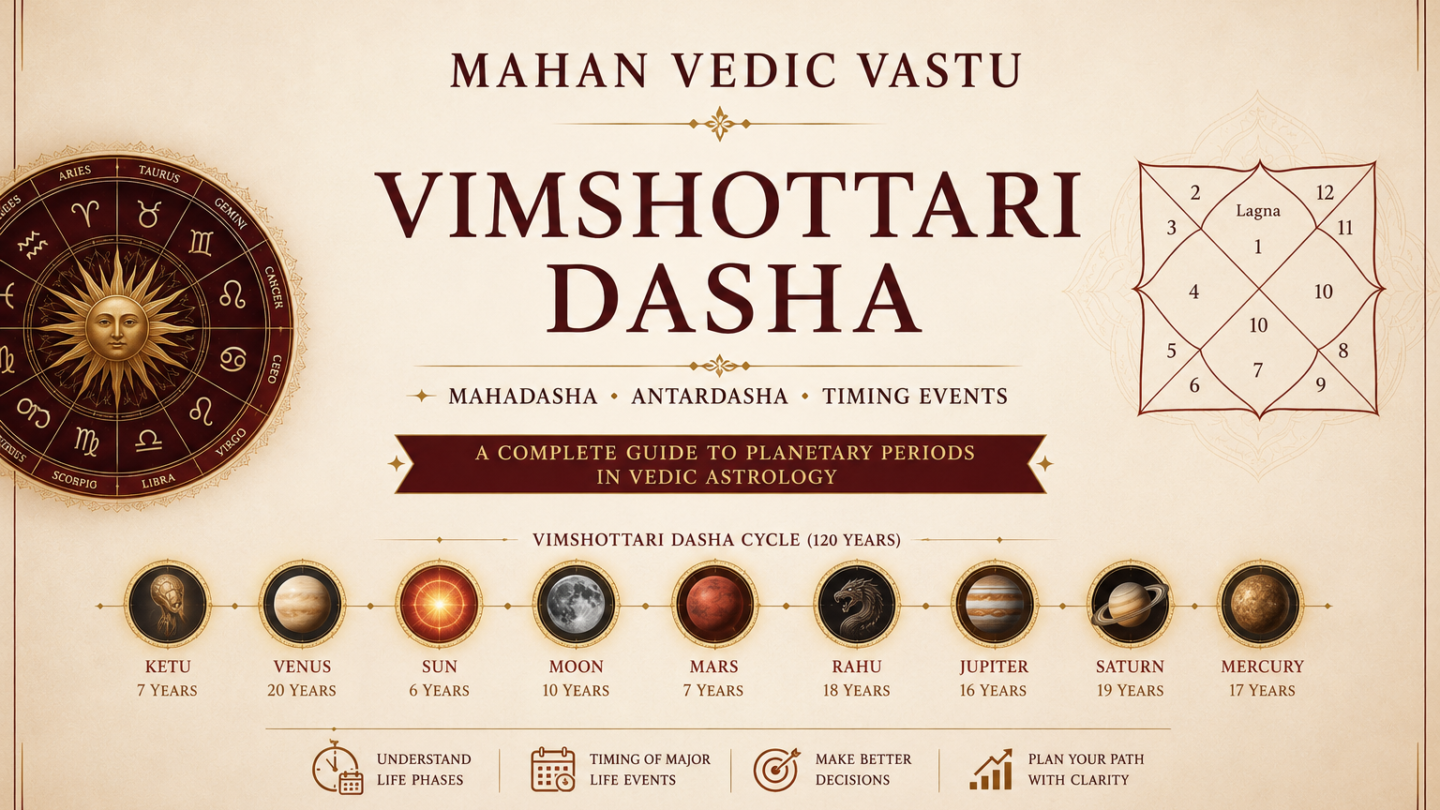
The complete Vimshottari cycle consists of 120 years, distributed among nine planetary rulers:
Planet Mahadasha Period
Ketu 7 years
Venus 20 years
Sun 6 years
Moon 10 years
Mars 7 years
Rahu 18 years
Jupiter 16 years
Saturn 19 years
Mercury 17 years
Together, these periods total 120 years.
The sequence remains fixed:
Ketu → Venus → Sun → Moon → Mars → Rahu → Jupiter → Saturn → Mercury
But everyone does not begin life at the start of Ketu Mahadasha.
The planetary period operating at birth depends on the Moon’s Nakshatra and the remaining portion of that Nakshatra at the time of birth.
What Is Mahadasha?
A Mahadasha is a major planetary period.
During a planet’s Mahadasha, the themes represented by that planet in the individual horoscope may become particularly significant.
But the name of the planet is not enough to predict the result.
For example:
“Jupiter Mahadasha = good fortune”
is too simplistic.
Before interpreting Jupiter Mahadasha, an astrologer should ask:
– Which houses does Jupiter rule?
– Which house does Jupiter occupy?
– In which sign is it placed?
– What is its strength and dignity?
– Which planets are associated with it?
– Which planets aspect it?
– Which houses does it influence?
– What combinations or Yogas involve Jupiter?
– What does the relevant divisional chart indicate?
– Which Antardasha is operating?
Only then can the planetary period be interpreted meaningfully.
What Is Antardasha?
Every Mahadasha contains smaller planetary sub-periods called Antardashas.
For example, during Saturn Mahadasha, the native will pass through combinations such as Saturn–Saturn, Saturn–Mercury, Saturn–Ketu, Saturn–Venus and so on according to the Vimshottari sequence.
This creates another level of timing.
The Mahadasha establishes a broad planetary period.
The Antardasha helps refine which planetary relationship is operating within that larger period.
A useful way to understand it is:
Mahadasha = the larger chapter
Antardasha = a section within that chapter
There are still deeper subdivisions used in advanced timing analysis, but Mahadasha and Antardasha provide an important practical foundation.
How Is Vimshottari Dasha Calculated?
The starting Vimshottari Dasha is linked to the Moon’s Nakshatra at birth.
Vedic Astrology uses 27 Nakshatras, and each Nakshatra is governed by one of the nine Dasha planets.
The planetary sequence repeats across the Nakshatras.
The Moon’s precise position determines:
1. the birth Nakshatra;
2. the planetary ruler of that Nakshatra; and
3. how much of that planet’s Mahadasha remains at birth.
Therefore, two people born during the same year—or even on the same day—may not necessarily have the same Dasha balance.
Accurate birth data and correct astronomical calculation are important.
Why Is Dasha Important in Birth Chart Analysis?
One of the fundamental challenges in astrology is distinguishing potential from timing.
Imagine that a horoscope contains strong professional combinations.
Does that mean career success must occur immediately?
Not necessarily.
The relevant planets and houses may become significantly activated during particular planetary periods.
Similarly, a chart may contain marriage indications, property combinations or foreign connections, but timing analysis helps examine when those themes have stronger activation.
This gives us an important principle:
The birth chart provides the foundation. Dasha helps identify the operating period. Transits can provide additional timing support.
None should normally be interpreted completely independently.
Can Mahadasha Predict Major Life Events?
Vimshottari Dasha can be used as part of the timing analysis for many important areas of life.
These can include:
– education;
– career;
– first employment;
– promotion;
– career change;
– business;
– marriage;
– relationships;
– children;
– property;
– vehicle;
– financial development;
– foreign travel;
– relocation;
– health-related periods;
– spiritual development; and
– major transitions.
However, the Dasha does not manufacture an event that has no meaningful connection with the horoscope.
A stronger prediction looks for confirmation between the natal chart and the active planetary periods.
Mahadasha Results Depend on Functional Lordship
This is one of the most important concepts to understand.
The same planet does not perform exactly the same role for every Ascendant.
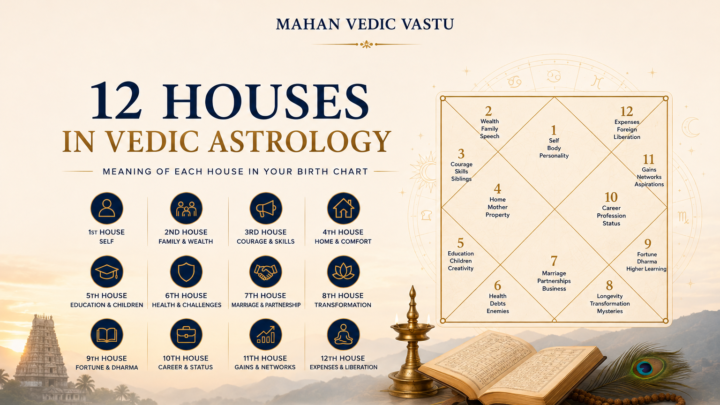
A planet rules different houses depending upon the Lagna.
Therefore, generic statements such as:
“Mercury Mahadasha always gives business success”
or
“Saturn Mahadasha always creates suffering”
are unreliable.
The astrologer first needs to determine the planet’s functional role in that particular horoscope.
This is one reason personalised Dasha analysis can differ substantially from generic online Mahadasha descriptions.
Sun Mahadasha
The Sun’s Mahadasha lasts 6 years.
The Sun naturally relates to themes such as:
– authority;
– identity;
– leadership;
– recognition;
– vitality;
– government;
– responsibility;
– father-related matters.
But the actual results of Sun Mahadasha depend upon its functional lordship, house position, sign, strength and planetary relationships.
A well-supported Sun may activate leadership or recognition themes.
A challenged Sun may require greater attention to authority, ego, responsibility or related areas.
The complete horoscope decides the expression.
Moon Mahadasha
The Moon Mahadasha lasts 10 years.
The Moon is traditionally connected with:
– mind;
– emotions;
– adaptability;
– mother;
– nurturing;
– public interaction;
– comfort;
– habits;
– mental responsiveness.
Because the Moon changes rapidly and plays an important role in Nakshatra-based timing, its condition deserves careful attention.
Its house lordship and natal placement determine which life areas become connected with the Moon period.
Mars Mahadasha
Mars Mahadasha lasts 7 years.
Mars represents themes including:
– action;
– courage;
– initiative;
– competition;
– technical ability;
– land;
– physical energy;
– assertion.
A constructive Mars period may support decisive action and achievement.
A more challenged Mars period may require better management of impatience, disputes or excessive risk.
Again, Mars should be interpreted according to the individual horoscope rather than its natural meaning alone.
Rahu Mahadasha
Rahu Mahadasha lasts 18 years, making it one of the longer major periods.
Rahu can be associated with:
– ambition;
– amplification;
– foreign environments;
– technology;
– unconventional experiences;
– new social environments;
– material desire;
– sudden changes;
– unfamiliar territory.
Rahu Mahadasha is sometimes described online in extremely frightening terms.
That is not a responsible approach.
Its results depend heavily on Rahu’s house position, sign context, dispositor, planetary associations, aspects and the houses it activates.
Rahu can produce very different experiences in different horoscopes.
Jupiter Mahadasha
Jupiter Mahadasha lasts 16 years.
Jupiter is naturally associated with:
– knowledge;
– growth;
– wisdom;
– teachers;
– guidance;
– principles;
– expansion;
– children;
– higher learning.
Although Jupiter is traditionally regarded as a natural benefic, Jupiter Mahadasha is not automatically positive for every person.
Its functional lordship and placement remain fundamental.
A planet cannot be interpreted from its natural classification alone.
Saturn Mahadasha
Saturn Mahadasha lasts 19 years.
Because this is a long period, Saturn Mahadasha can cover major phases of adult development.
Saturn is traditionally connected with:
– discipline;
– work;
– responsibility;
– endurance;
– structure;
– delay;
– maturity;
– persistence;
– long-term development.
Saturn should not automatically be feared.
Depending upon the horoscope, Saturn periods may coincide with substantial responsibility and sustained effort, but those same qualities can contribute to long-term achievement.
The chart determines whether Saturn operates primarily through constructive structure, challenge, or a combination of both.
Mercury Mahadasha
Mercury Mahadasha lasts 17 years.
Mercury is associated with:
– intelligence;
– communication;
– calculation;
– learning;
– commerce;
– analysis;
– writing;
– information;
– adaptability.
For some charts, Mercury periods may strongly activate education, business, communication or analytical work.
For others, completely different house connections may become more important.
The functional role of Mercury must therefore be established first.
Ketu Mahadasha
Ketu Mahadasha lasts 7 years.
Ketu is traditionally associated with:
– detachment;
– internalisation;
– research;
– specialised knowledge;
– spiritual inquiry;
– separation;
– unconventional experiences.
Ketu should not automatically be interpreted as negative.
Its dispositor, house placement, associations and relationship with the rest of the horoscope significantly modify its expression.
Venus Mahadasha
Venus Mahadasha lasts 20 years, the longest period in the Vimshottari sequence.
Venus naturally relates to:
– relationships;
– attraction;
– comforts;
– aesthetics;
– creativity;
– luxury;
– artistic expression;
– agreements.
A 20-year Mahadasha can cover several major stages of life, so it would be particularly misleading to describe the entire period with one generic prediction.
Different Antardashas can substantially change the themes operating within the Venus Mahadasha.
Mahadasha and Antardasha Combination
Suppose a person is running:
Jupiter Mahadasha – Saturn Antardasha
A meaningful interpretation should not simply combine:
Jupiter = expansion
and
Saturn = delay.
Instead, the astrologer studies:
– Jupiter’s functional role;
– Saturn’s functional role;
– houses ruled by both planets;
– their natal positions;
– whether they connect with each other;
– houses they activate;
– relevant divisional charts;
– and current transits.
This can reveal which areas of life are most likely to become prominent during that particular period.
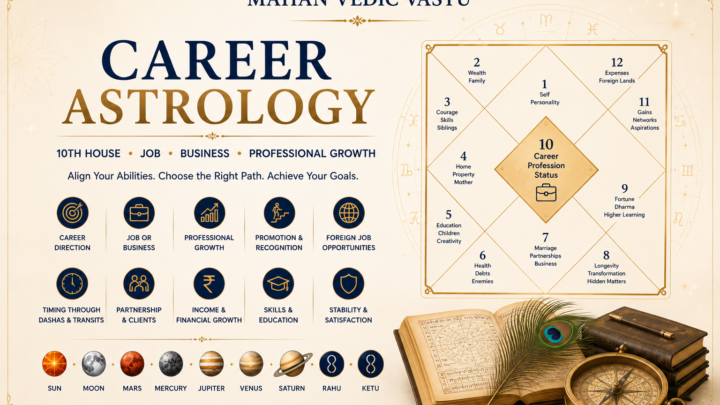
Vimshottari Dasha for Career
For career timing, the astrologer first establishes the professional promise of the horoscope.
Important factors may include:
– 10th house;
– 10th lord;
– 6th house;
– 2nd house;
– 11th house;
– relevant planets;
– Dasamsa or D10 chart.
Then the Dasha sequence is examined.
Periods involving strongly connected career planets may coincide with developments such as employment, promotion, increased responsibility, professional change or business activity when supported by the rest of the chart.
You can also read our dedicated Career Astrology guide for a deeper understanding of professional birth-chart analysis.
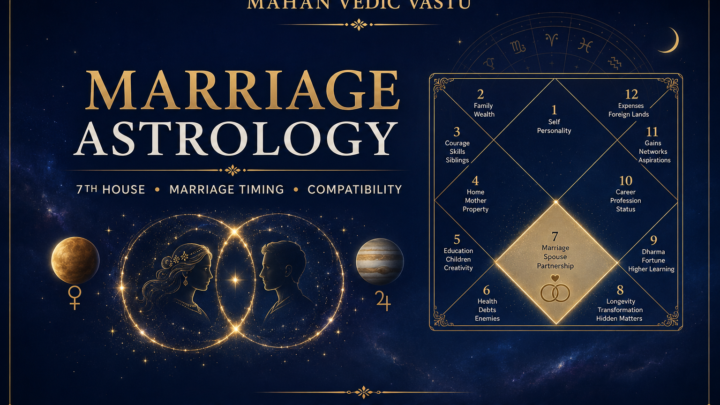
Vimshottari Dasha for Marriage
For marriage timing, the astrologer first examines the natal marriage indicators.
These can include:
– 7th house;
– 7th lord;
– Venus;
– Jupiter;
– relevant relationship houses;
– Navamsa or D9;
– planetary connections.
Then the Dasha and Antardasha periods capable of activating those factors are studied.
This is why marriage timing should not be predicted simply because Jupiter enters a particular sign.
Our dedicated Marriage Astrology article explains the broader 7th-house, Navamsa and marriage-timing framework.
Dasha and Transit: What Is the Difference?
This distinction is essential.
Dasha
Dasha describes the planetary period operating for the individual according to the natal horoscope.
Transit
Transit describes the current movement of planets through the zodiac.
Two people experience the same general planetary sky at a given moment, but their Dashas and birth charts may be completely different.
That is why the same Saturn or Jupiter transit does not produce identical results for everyone.
A stronger timing framework is:
Natal Chart → Dasha → Antardasha → Relevant Divisional Chart → Transit Confirmation
Why Generic Mahadasha Predictions Often Fail
Search for any Mahadasha online and you may encounter statements such as:
“Your next 18 years will be difficult.”
“Jupiter Mahadasha guarantees wealth.”
“Saturn will destroy your career.”
“Venus Mahadasha guarantees marriage.”
These statements ignore the architecture of the individual horoscope.
A planet can rule favourable houses in one chart and very different houses in another.
It can be strong in one horoscope and challenged in another.
Its Antardasha combinations also change throughout the Mahadasha.
Therefore, generic planet-based predictions cannot substitute for chart-specific analysis.
How Mahan Vedic Vastu Approaches Dasha Analysis
At Mahan Vedic Vastu, the objective is not to label a Mahadasha simply as good or bad.
A structured analysis asks:
1. What is promised by the natal chart?
2. What houses does the Mahadasha planet rule?
3. Where is it placed?
4. What is its strength?
5. Which planets influence it?
6. Which houses does it connect?
7. What does the relevant divisional chart indicate?
8. Which Antardasha is operating?
9. What events have already occurred during the period?
10. Which current or upcoming transits support activation?
This produces a more useful question than:
“Is my Mahadasha lucky?”
The better question is:
“Which areas of my horoscope are being activated during this period, and how should that period be understood?”
For an individual analysis of your current and upcoming planetary periods, you can explore the Mahan Vedic Vastu Astrology Consultation.
Learn Vimshottari Dasha Systematically
Vimshottari Dasha becomes much easier to understand once the student stops memorising generic predictions and starts connecting planetary periods with the natal chart.
A serious study requires understanding:
Lagna → Houses → House Lords → Planets → Nakshatras → Yogas → Divisional Charts → Mahadasha → Antardasha → Transits
If you want to develop this structured approach to horoscope interpretation, explore the Mahan Vedic Vastu Astrology Course.
For personalised analysis of an important career, marriage, business or life period, you can also Book a Consultation.
Frequently Asked Questions About Vimshottari Dasha
What is Vimshottari Dasha?
Vimshottari Dasha is a planetary-period system used in Vedic Astrology to study the timing and development of planetary themes across different phases of life.
How long is the complete Vimshottari Dasha cycle?
The complete cycle is 120 years, distributed among Ketu, Venus, Sun, Moon, Mars, Rahu, Jupiter, Saturn and Mercury.
What is Mahadasha?
Mahadasha is the major planetary period within the Vimshottari Dasha system. Each of the nine planets receives a defined duration.
What is Antardasha?
Antardasha is a planetary sub-period operating within a Mahadasha. It helps refine the themes and timing of the larger planetary period.
How is the first Mahadasha determined?
The starting Mahadasha is determined from the Moon’s Nakshatra at birth, while the Moon’s exact position within that Nakshatra determines the remaining balance of the period.
Which Mahadasha is the best?
There is no universally best Mahadasha. Results depend on the planet’s house lordship, placement, strength, associations and overall role in the individual horoscope.
Is Saturn Mahadasha always bad?
No. Saturn Mahadasha should not automatically be classified as negative. Saturn can represent discipline, responsibility, endurance and long-term development as well as challenges, depending on the horoscope.
Is Jupiter Mahadasha always good?
No. Although Jupiter is naturally classified as a benefic, its actual Mahadasha results depend upon its functional role and condition in the individual chart.
Can Vimshottari Dasha predict marriage?
It can form an important part of marriage timing analysis when the operating periods activate marriage-related houses and planets supported by the natal chart, Navamsa and relevant transits.
Can Dasha predict career changes?
Career-related Dashas and Antardashas can be studied for periods of employment, promotion, business activity, professional transition or increased responsibility when the natal career indicators support those themes.
Which is more important: Dasha or transit?
They perform different functions and should generally be studied together. Dasha describes the individual’s active planetary period, while transits describe current planetary movement interacting with the natal horoscope.
Can I predict my future only from Mahadasha?
A Mahadasha alone is insufficient for detailed prediction. The natal horoscope, Antardasha, relevant divisional charts, planetary relationships and transits should also be considered.
Vimshottari Dasha becomes most meaningful when it is used as part of an integrated prediction framework. The birth chart establishes the underlying possibilities, Mahadasha and Antardasha identify the planetary periods operating in the individual’s life, divisional charts refine specific areas, and transits can provide additional timing confirmation. Rather than asking whether a planet is universally “good” or “bad,” a more useful Vedic Astrology analysis asks what that planet represents in this particular horoscope, which areas it activates, and when those themes are most relevant.
Editorial note: This article presents Vedic Astrology as a traditional interpretive system for education and self-reflection. Astrological timing indicates interpretive periods and possibilities rather than guaranteed events. Important medical, financial, legal, relationship or career decisions should also consider appropriate professional advice and real-world circumstances.