The main entrance is one of the most discussed areas in Vastu Shastra. People often ask whether an east-facing entrance is best, whether a south-facing entrance is harmful, or whether simply changing the main door can improve the Vastu of a home.
In a detailed Vastu analysis, the main entrance is not judged only by whether it faces north, south, east or west. Its exact position within the directional zone, the internal layout of the house, room placement, the Brahmasthan, surrounding environment and the way the property is used can all contribute to the overall assessment.
This is especially important because a building can have an entrance on the same side as another building but occupy a different entrance segment.
Therefore, instead of asking only:
“Which direction is best for the main entrance?”
a more useful question is:
“Where exactly is the entrance located within the directional framework of the property, and how does it interact with the rest of the house?”
This guide explains the fundamentals of main entrance Vastu, the four principal directions, the concept of 32 entrances, common mistakes and when a detailed Vastu analysis may be useful.
For a broader understanding of residential Vastu, also read our Vastu Shastra for Home guide.
Main Entrance Vastu: The Quick Answer
The main entrance is the principal access point through which people enter and leave a property.
In Vastu analysis, its location is important, but judging it merely as north-facing, east-facing, south-facing or west-facing can be too broad.
A more detailed assessment considers:
| Factor | What to Examine |
|---|---|
| Facing direction | North, East, South or West |
| Exact entrance location | Position of the door along that side |
| Vastu zone | The zone in which the entrance falls |
| Internal layout | Kitchen, bedrooms, toilets, staircase and other functions |
| Brahmasthan | Condition of the central area |
| External surroundings | Roads, neighbouring structures and site conditions |
| Property use | Residential, commercial, office, factory, etc. |
Key principle: The facing direction gives an initial reference, but it should not automatically become the final Vastu judgement.
Why Is the Main Entrance Important in Vastu?
The main entrance creates the transition between the external environment and the internal living space.
From a practical perspective, it determines movement into the property and influences how the entrance area is experienced. In traditional Vastu interpretation, the entrance is also examined in relation to directional qualities and the functional arrangement of the building.
This is why entrance analysis is normally considered together with the complete floor plan rather than as an isolated feature.
For example, two houses may both be described as north-facing.
However:
- their doors may occupy different positions along the northern side;
- their kitchens may be located in different zones;
- their bedrooms and toilets may differ;
- their central areas may be organised differently;
- and their surrounding site conditions may not be the same.
Calling both properties simply “north-facing houses” therefore does not provide enough information for a detailed Vastu assessment.
How to Find the Main Entrance Direction
Before applying entrance Vastu principles, the direction must first be identified correctly.
A compass reading should be taken carefully rather than assuming the direction from sunrise, road position or the general orientation of neighbouring houses.
The four cardinal directions are:
- North
- East
- South
- West
Between them lie the intermediate directions:
- North-East
- South-East
- South-West
- North-West
More detailed Vastu analysis divides the directional perimeter further to study entrance positions more precisely.
Avoid a Common Direction Mistake
One common mistake is determining the direction casually while standing somewhere inside the property without following a consistent measurement method.
Compass readings can also be affected by nearby metal objects, electronic devices and environmental interference.
Students who want to understand direction measurement, zones, entrances and floor-plan analysis systematically can explore the Mahan Vedic Vastu Vastu Course.
Which Direction Is Best for the Main Entrance?
There is no responsible universal rule stating that one entire direction is always good and another entire direction is always bad.
You may frequently encounter simplified statements online such as:
“East-facing houses are always auspicious.”
or:
“Never buy a south-facing house.”
These statements are too broad for detailed Vastu analysis.
The exact entrance position and the rest of the property’s configuration need to be considered.
Let us examine the four major directions separately.
North-Facing Main Entrance Vastu
A north-facing property has its principal frontage or entrance orientation towards the north.
In traditional Vastu interpretation, north is often associated with growth, movement and financial activity. However, this does not mean every door anywhere on the northern side automatically produces the same result.
The exact position of the entrance along the northern side should be identified.
A proper assessment can therefore ask:
- Where exactly is the main door?
- Which entrance division contains it?
- What functions occupy the neighbouring zones?
- Where are the kitchen and bedrooms?
- What is happening in the centre of the property?
- How is the external environment affecting the site?
The entire floor plan matters.
East-Facing Main Entrance Vastu
East-facing homes are frequently described as favourable in popular Vastu content.
But again, east-facing alone is not enough to determine the quality of a property.
The eastern side contains multiple possible entrance positions. A detailed assessment identifies the actual entrance location rather than classifying every east-facing door identically.
The property’s internal arrangement must also be studied.
Therefore:
East-facing ≠ automatically perfect Vastu.
It is one factor within a larger spatial analysis.
South-Facing Main Entrance Vastu
South-facing houses are probably among the most misunderstood properties in Vastu.
A common fear is:
“A south-facing entrance is always bad.”
This is an oversimplification.
A south-facing property should be analysed according to the precise entrance position and the complete floor plan rather than rejected merely because of the word south.
Before making a major decision about buying, selling or modifying a south-facing property, a complete analysis is more useful than relying on a generic directional rule.
West-Facing Main Entrance Vastu
West-facing homes should be approached in the same way.
The entire western side should not be treated as one identical entrance location.
A Vastu assessment examines the precise door position along with other aspects of the house.
Therefore:
West-facing ≠ automatically good or bad.
The detailed configuration determines how the property should be interpreted.
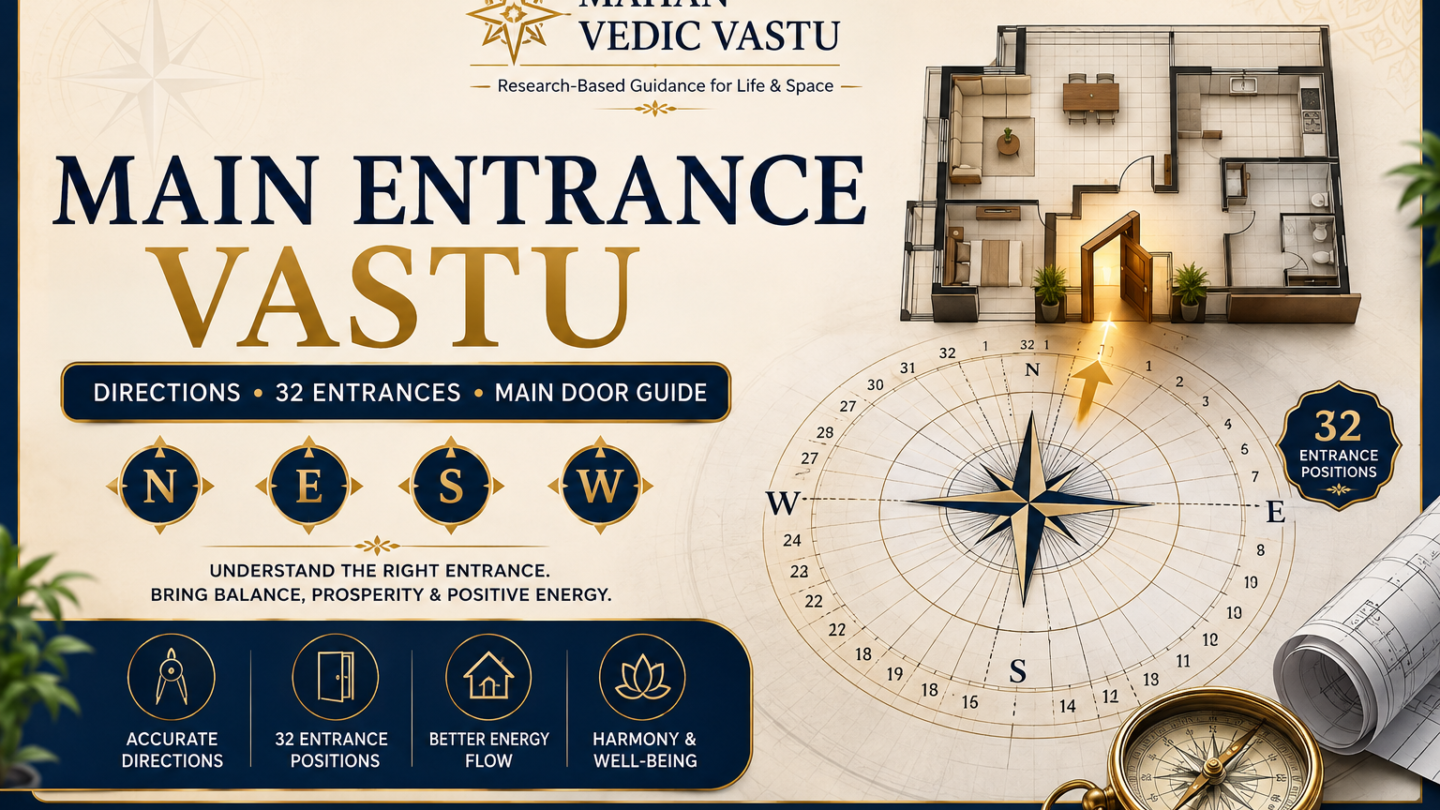
What Are the 32 Entrances in Vastu?
This is where entrance analysis becomes considerably more precise.
Instead of considering only the four broad directions, an advanced Vastu framework divides the perimeter into 32 entrance positions.
This allows the entrance to be studied with greater precision.
Conceptually:
4 major directions × 8 divisions = 32 entrance positions
So rather than saying:
“The door is in the north.”
a detailed analysis asks:
“Where exactly along the northern side is the entrance located?”
This distinction is one reason why two apparently similar north-facing or east-facing properties may receive different Vastu interpretations.
Readers who want to explore the broader framework of directions, zones and property analysis can continue through the Mahan Vedic Vastu Vastu Guides.
32 Entrances vs 16 Vastu Zones
These concepts are related, but they should not be treated as identical.
The 16 Vastu zones provide a more detailed directional framework for analysing different areas and activities within a property.
The 32 entrances provide a finer division for examining entrance locations around the perimeter.
A professional floor-plan analysis can therefore consider both:
Where is the entrance located?
and
How are the important functions of the property distributed among the zones?
This produces a much more meaningful picture than evaluating the main door alone.
Main Door Vastu: Practical Points to Consider
Beyond directional analysis, the physical condition and usability of the entrance also deserve attention.
A main entrance should generally be:
- clearly identifiable;
- easy to access;
- properly maintained;
- adequately illuminated;
- capable of opening and closing smoothly;
- free from unnecessary obstruction;
- proportionate to the property;
- and kept reasonably clean and organised.
These are practical qualities that improve the experience of entering a home regardless of the property’s directional configuration.
Should the Main Door Open Inward or Outward?
For a residential entrance, an inward-opening main door is commonly preferred in Vastu practice where the architectural design and safety requirements permit it.
However, practical considerations must come first.
The door should not:
- obstruct circulation;
- create a safety hazard;
- interfere with another door;
- damage furniture or walls;
- or violate applicable building or fire-safety requirements.
Vastu recommendations should work with functional architecture rather than against it.
Main Entrance Vastu Dos
Useful entrance practices include maintaining a clean and functional approach to the property.
Where practical:
- Keep the entrance well maintained.
- Ensure sufficient lighting.
- Repair damaged doors, locks and hinges.
- Keep the approach reasonably uncluttered.
- Make the entrance easy for visitors to identify.
- Maintain comfortable movement through the doorway.
- Consider the entrance together with the complete floor plan.
The last point is particularly important.
A beautiful entrance does not compensate automatically for every other spatial issue within a property.
Main Entrance Vastu Don’ts
Avoid making major property decisions based solely on generic online rules.
In particular, avoid:
- assuming every east-facing house is automatically ideal;
- rejecting every south-facing property automatically;
- evaluating the door without measuring its actual direction;
- confusing the property’s facing direction with the exact entrance position;
- applying the same remedy to every house;
- demolishing or relocating structural elements without proper analysis;
- ignoring the internal floor plan;
- or judging a property from a single Vastu factor.
Vastu is more useful when the property is treated as an interconnected spatial system.
Common Main Entrance Vastu Mistakes
Mistake 1: Looking Only at the Four Directions
North, east, south and west are useful starting points, but detailed entrance analysis can go beyond these four broad classifications.
Mistake 2: Assuming East and North Are Always Good
An entire side of a property should not automatically be labelled favourable simply because it faces east or north.
Exact placement matters.
Mistake 3: Assuming South Is Always Bad
This is one of the most widespread misconceptions in simplified Vastu content.
A south-facing property requires analysis rather than automatic rejection.
Mistake 4: Checking the Entrance but Ignoring the Floor Plan
The entrance is only one part of the house.
A complete analysis may also examine the kitchen, bedrooms, toilets, staircase, centre, room functions and external surroundings.
Mistake 5: Applying Remedies Before Diagnosing the Property
A remedy should address an identified issue.
Randomly adding objects, colours, symbols or structural modifications without understanding the underlying layout can create confusion rather than clarity.
What If My Main Entrance Is in an Unfavourable Position?
Do not immediately assume that the door must be demolished or relocated.
First establish:
- the accurate direction;
- the exact entrance position;
- the surrounding Vastu zones;
- the complete floor-plan arrangement;
- the use of each important space;
- and whether there is actually a significant imbalance requiring attention.
In many existing homes, major structural modification may be impractical.
For that reason, the Mahan Vedic Vastu approach prioritises practical and non-destructive corrections wherever appropriate, based on the complete property rather than fear-based assumptions.
For property-specific analysis, see our Vastu Consultation service.
Should I Change My Main Entrance According to Vastu?
Not merely because a generic article or video says your direction is unfavourable.
Changing a main entrance can involve:
- structural work;
- architectural consequences;
- security considerations;
- waterproofing or electrical work;
- changes to circulation;
- and substantial expense.
A structural change should therefore never be the first reaction to a simplified Vastu rule.
Analyse first. Modify only when justified.
Main Entrance Vastu for Flats and Apartments
Apartment Vastu requires additional care because the resident does not control the entire building.
Factors may include:
- the apartment’s entrance;
- orientation of the individual unit;
- internal room arrangement;
- location within the building;
- common corridors;
- lifts and staircases;
- and surrounding built environment.
It is therefore risky to judge an apartment from the main gate of the entire apartment complex alone.
The individual unit should be analysed separately.
Main Entrance Vastu for an Existing Home
Existing houses present different challenges from properties still in the planning stage.
If the house is already constructed, the objective should normally be to understand:
What is working well?
What requires attention?
What can realistically be improved?
This is where a non-destructive-first approach becomes valuable.
Instead of creating fear around a single entrance position, the aim should be to identify practical improvements while preserving functional architecture wherever possible.
Main Entrance Vastu for a New House
A property that is still being designed offers more flexibility.
Before construction, it may be possible to coordinate:
- plot orientation;
- entrance position;
- room placement;
- kitchen location;
- bedrooms;
- toilets;
- staircase;
- Brahmasthan;
- circulation;
- and other architectural requirements.
Planning these factors together is generally easier than trying to correct them after construction.
If you are designing a new house, analysing the plan before construction begins can therefore be particularly useful.
Main Entrance Vastu and the Complete Home
One of the most important lessons is that the main entrance should not be analysed in isolation.
Consider two homes with entrances in similar positions.
House A may have:
- a well-organised central area;
- appropriately positioned functional spaces;
- balanced circulation;
- and supportive external conditions.
House B may have:
- very different room placements;
- obstructions;
- unsuitable functional use of certain zones;
- or different external influences.
The entrance alone cannot explain the entire property.
This is why a complete residential assessment should move from:
Direction → Entrance → Zones → Rooms → Centre → Surroundings → Overall interaction
rather than stopping at:
“Which way does the door face?”
When Should You Consider a Professional Vastu Analysis?
General educational guides are useful for understanding principles.
A property-specific consultation becomes more relevant when you are:
- buying a house or flat;
- selecting between multiple properties;
- constructing a new home;
- finalising a floor plan;
- renovating an existing property;
- concerned about an entrance location;
- planning major structural changes;
- or receiving conflicting Vastu advice.
A consultation can examine the property as a whole instead of relying on a single directional rule.
You can learn more through the Mahan Vedic Vastu Vastu Consultation or submit your details through the Premium Consultation Application.
Learn Vastu Systematically
If you want to go beyond basic tips and understand how Vastu analysis is actually performed, systematic learning is more useful than memorising isolated rules.
A structured study can include:
- compass and direction measurement;
- 16 Vastu zones;
- 32 entrances;
- Five Elements;
- room placement;
- Brahmasthan;
- floor-plan analysis;
- residential and commercial applications;
- and practical correction principles.
Explore the Mahan Vedic Vastu Vastu Course for structured learning.
For educational articles and reference material, visit the Vastu Guides.
Frequently Asked Questions About Main Entrance Vastu
Which direction is best for the main entrance according to Vastu?
The direction alone should not determine whether an entrance is considered favourable. A detailed analysis examines the exact entrance position along with the property’s zones, internal layout and surrounding conditions.
Is a south-facing main entrance bad according to Vastu?
A south-facing entrance should not automatically be labelled bad. The exact location of the entrance on the southern side and the overall floor plan need to be analysed before reaching a conclusion.
Is an east-facing entrance always good?
No. East-facing is a broad directional description. Different entrance positions can exist along the eastern side, and the rest of the property’s layout also matters.
Is a north-facing house good according to Vastu?
North-facing properties are commonly considered favourably in popular Vastu discussions, but facing direction alone is insufficient for a complete assessment. Exact entrance placement and the internal configuration should also be considered.
What are the 32 entrances in Vastu?
A detailed Vastu entrance framework divides the perimeter into 32 entrance positions. This provides greater precision than describing a door only as north-, east-, south- or west-facing.
Are 16 Vastu zones and 32 entrances the same?
No. They are related directional frameworks but serve different analytical purposes. The 16 zones help analyse spatial functions, while the 32-entrance framework provides more detailed entrance positioning.
Should I change my main door if its Vastu is not ideal?
Not automatically. First confirm the direction, exact entrance position and complete property layout. Structural changes should be considered only after proper analysis and with architectural and safety requirements in mind.
Can Vastu problems be corrected without demolition?
Depending on the property and the issue identified, practical non-destructive corrections may be possible. The appropriate approach depends on the complete layout rather than a universal remedy.
How do I check my main entrance direction accurately?
Use a reliable compass and a consistent measurement method while minimising interference from metal objects and electronics. For detailed analysis, the reading should then be mapped against the property’s floor plan.
Does the main entrance alone decide the Vastu of a house?
No. The main entrance is important, but the complete property may include room placement, zones, Brahmasthan, circulation, surrounding environment and other factors. A single feature should not be treated as the entire Vastu analysis.
Understand the Entrance — Then Understand the Whole Property
The main entrance is an important part of residential Vastu, but its meaning becomes clearer when it is studied as part of the entire property.
Start with accurate direction measurement.
Then identify the exact entrance location.
Next examine the zones, rooms, central area and surrounding environment.
This approach moves Vastu away from simplistic rules such as “north is good” or “south is bad” and towards a more structured analysis of the complete living space.
Continue learning through the Vastu Guides, study the subject systematically through the Vastu Course, or choose a professional Vastu consultation when you need property-specific guidance.
Editorial Note
Vastu Shastra is a traditional system of spatial planning and interpretation. The information in this guide is intended for educational purposes and should not be treated as a guaranteed prediction of health, wealth, relationships or future events.
Architectural, structural, electrical, plumbing and safety decisions should always be reviewed by appropriately qualified professionals.