Understanding Vastu directions for home is one of the foundations of a detailed Vastu analysis.
Many people know only the four primary directions—North, South, East and West. Others are familiar with the four corner directions—North-East, South-East, South-West and North-West.
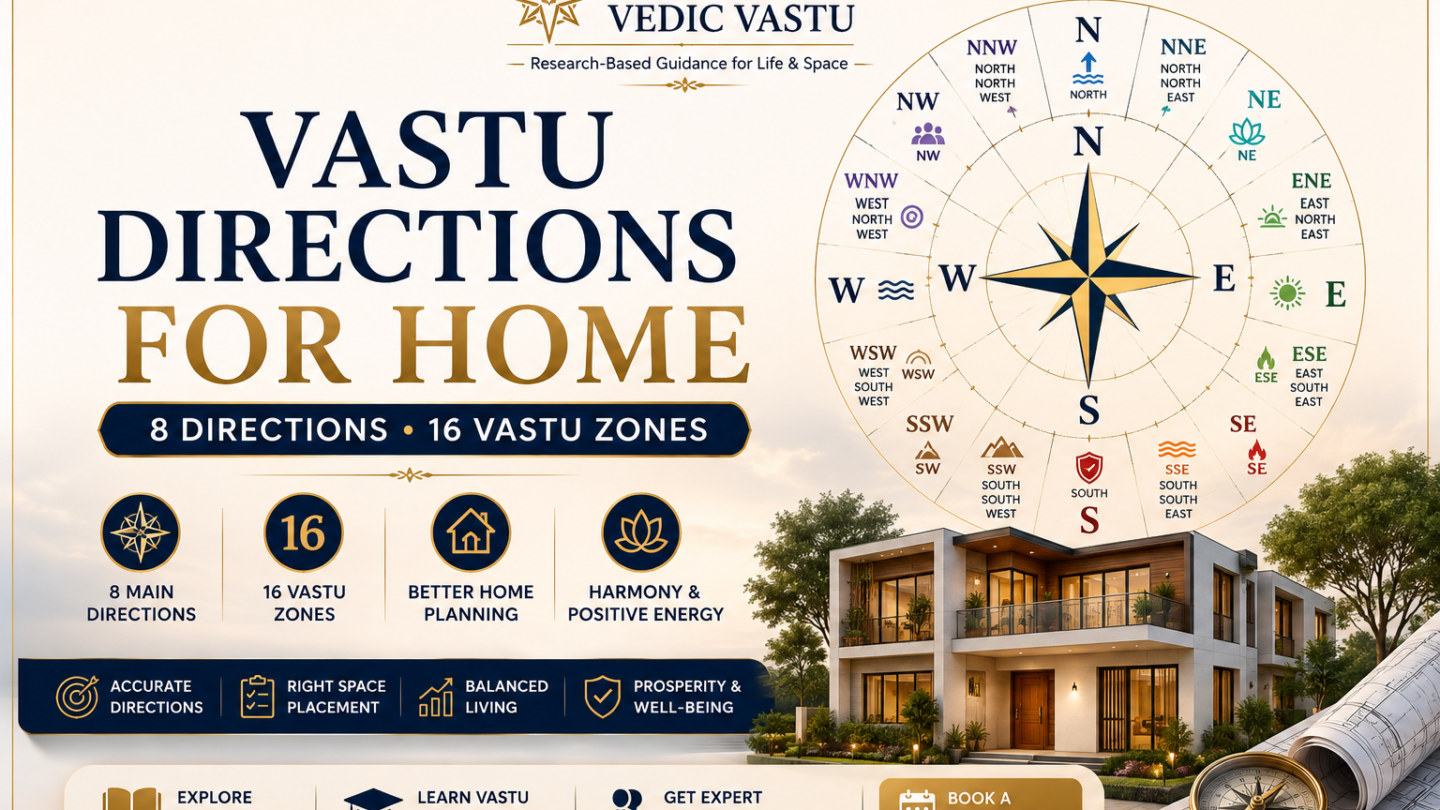
Together, these create the 8 main directions in Vastu.
However, a more detailed directional analysis goes further. The complete 360-degree space around a property can be studied through 16 directional zones, while the perimeter can be examined more precisely when analysing important factors such as the main entrance.
This distinction is important.
Simply saying that a kitchen is “in the East” or an entrance is “North-facing” may not always provide enough information for detailed analysis. Its exact location within the directional division can change how the space is interpreted.
In this guide, we will understand the 8 directions, the 16 Vastu zones, their broad significance, and how directional analysis relates to important areas such as the entrance, kitchen, bedroom, pooja room and living spaces.
What Are Directions in Vastu Shastra?
Direction is one of the basic reference systems used to understand the position of different activities and spaces within a building.
The four cardinal directions are:
- North
- East
- South
- West
Between them are four intermediate directions:
- North-East
- South-East
- South-West
- North-West
Together they form the 8 principal directions used in Vastu analysis.
For greater precision, each 45-degree directional sector can be divided further, creating 16 Vastu zones.
This allows a practitioner to move beyond broad statements such as “this room is in the North” and examine the location more accurately.
Why Are Vastu Directions Important for a Home?
A house contains many different activities.
We cook, sleep, work, study, pray, socialise, store possessions and enter or leave the building through different parts of the property.
Vastu does not treat all of these activities as identical.
The principle is that different areas of a building have different functional qualities, and the purpose assigned to a particular space should be considered in relation to its location.
This is why directional analysis is commonly used when studying:
- the main entrance
- kitchen
- master bedroom
- children’s bedroom
- pooja or meditation space
- study area
- toilets
- staircase
- living room
- storage
- water-related features
- working areas
A proper analysis therefore asks more than:
“Which direction does my house face?”
It also asks:
“What exactly is located in each zone of the house?”
That is a much more useful question.
The 8 Main Vastu Directions
The eight principal directions provide the first layer of understanding.
| Direction | Common Vastu Association |
|---|---|
| North | Flow, opportunities and movement |
| North-East | Clarity, contemplation and spiritual activity |
| East | Activity, visibility and beginnings |
| South-East | Fire and transformation |
| South | Strength and activity |
| South-West | Stability and grounding |
| West | Consolidation and support |
| North-West | Movement, transition and interaction |
These descriptions should be treated as broad principles rather than as a complete diagnosis of a property.
A direction cannot be evaluated properly without considering what occupies it, the exact zone, entrance location, floor plan and the overall relationship between different parts of the building.
What Are the 16 Vastu Zones?
The 16 Vastu zones provide a more detailed division of the full 360-degree space.
They are:
- North — N
- North-North-East — NNE
- North-East — NE
- East-North-East — ENE
- East — E
- East-South-East — ESE
- South-East — SE
- South-South-East — SSE
- South — S
- South-South-West — SSW
- South-West — SW
- West-South-West — WSW
- West — W
- West-North-West — WNW
- North-West — NW
- North-North-West — NNW
Each of these represents a 22.5-degree sector of the full 360-degree circle.
This finer division is one reason professional Vastu analysis should not rely only on broad labels such as North, South, East or West.
8 Directions vs 16 Zones: What Is the Difference?
This is one of the most important concepts for beginners to understand.
The 8-direction model provides the broad directional framework.
The 16-zone model provides greater positional precision.
For example, two rooms may both appear to occupy the eastern side of a house when viewed casually.
But one may actually fall predominantly within East-North-East, while another may occupy East-South-East.
They should therefore not automatically be interpreted in exactly the same way.
This becomes particularly relevant when evaluating important functions such as entrances, kitchens, bedrooms, toilets and other major structural features.
North Direction in Vastu
North is an important directional sector in Vastu and is traditionally associated with movement, opportunities and financial activity.
But saying that something is simply “in the North” is only the beginning of an analysis.
The practitioner should also examine whether it lies specifically within North-North-West, North or North-North-East and how that function interacts with the rest of the floor plan.
Openings, entrances, work areas and other activities therefore need to be evaluated in context rather than through a single universal rule.
North-East Direction in Vastu
The North-East direction, traditionally known as Ishanya, is generally associated with clarity, contemplation and spiritual or reflective activities.
For this reason, pooja, meditation and similar quiet activities are often considered in relation to this area.
However, modern apartments frequently have fixed layouts.
A toilet, bedroom, structural column or other unavoidable feature may already occupy part of the North-East.
Such a situation should not automatically create fear.
The complete floor plan should first be assessed before deciding whether an actual imbalance exists and what practical correction, if any, is appropriate.
East Direction in Vastu
East is traditionally connected with sunrise, activity, visibility and new beginnings.
Natural morning light can also make eastern portions of a home pleasant for activities that benefit from brightness and openness.
But an “East-facing house” should not automatically be labelled good or bad.
The exact position of the entrance and the internal layout remain important.
This is why entrance analysis requires more precision than merely identifying the facing direction of the building.
For a deeper explanation, read our Main Entrance Vastu guide
South-East Direction in Vastu
South-East is traditionally associated with the fire element.
Because cooking involves fire and heat, the kitchen is frequently studied in relation to the South-East.
However, professional analysis should examine more than the room label.
The location of the stove, sink, electrical appliances, person’s cooking orientation, adjacent spaces and exact directional sector can all contribute to the interpretation.
Therefore, the commonly searched question—
“Which direction is best for the kitchen as per Vastu?”
—cannot always be answered accurately from a single rule without seeing the floor plan.
South Direction in Vastu
South is another important part of the directional framework and should not automatically be considered negative.
One of the common misconceptions about Vastu is that an entire direction is inherently “bad.”
That oversimplifies the subject.
Every direction has a role.
What matters is how that part of the building is being used, its proportion, openings, structural characteristics and relationship with the other zones.
The same principle applies to South-facing properties.
A property should not be rejected merely because someone says that “South-facing houses are bad.”
Detailed entrance and floor-plan analysis is far more meaningful.
South-West Direction in Vastu
South-West is generally associated with stability, control and grounding.
This is why the master bedroom is often considered in relation to this part of a home.
A strong South-West does not simply mean filling the area with heavy objects.
The complete structural relationship should be considered, including openings, extensions, cuts, room usage and the overall floor plan.
Vastu works best when these factors are interpreted together rather than as isolated tips.
West Direction in Vastu
West has its own functional role within a home and can support several activities depending on the exact zone and layout.
Once again, it is important not to divide Vastu into simplistic ideas such as:
North and East = good
South and West = bad
A well-planned property can use all directions appropriately.
The objective is not to eliminate certain directions. It is to understand the relationship between direction and function.
North-West Direction in Vastu
North-West is traditionally associated with movement, transition and interaction.
Guest-related functions and spaces involving temporary movement are therefore often discussed in connection with this direction.
But the exact location remains important because North-West is bordered by West-North-West and North-North-West.
The 16-zone system allows these differences to be examined more precisely.
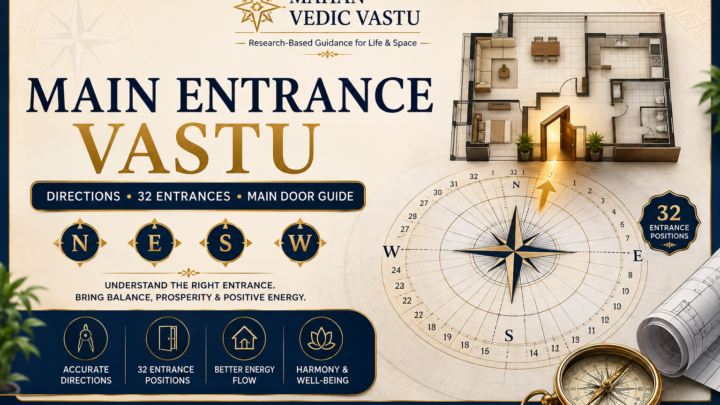
Which Direction Is Best for the Main Entrance?
This is one of the most searched Vastu questions—and also one of the most misunderstood.
A main entrance should not be judged only by saying:
“North entrance is good.”
or:
“South entrance is bad.”
Detailed Vastu analysis considers the exact position of the entrance within the directional perimeter.
This is where the concept of 32 entrances in Vastu becomes relevant.
Two houses may both be described as North-facing, yet their doors may occupy different entrance divisions.
Their Vastu interpretation therefore need not be identical.
Read the complete explanation here:
Main Entrance Vastu: Best Directions, 32 Entrances & Door Placement
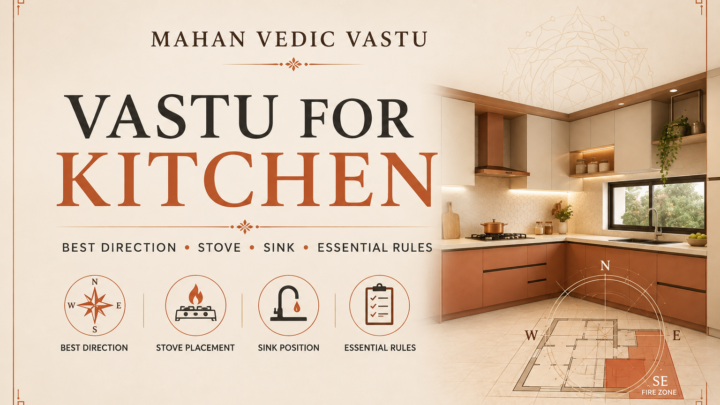
What Is the Best Direction for a Kitchen?
South-East is traditionally associated with fire and is therefore commonly preferred when planning a kitchen.
North-West may also be considered in certain layouts.
However, the kitchen should not be analysed only by its room position.
A detailed review may consider:
- kitchen zone
- cooking position
- stove location
- sink location
- water and fire relationship
- electrical appliances
- openings
- surrounding rooms
This is particularly important when analysing existing flats where major structural changes may not be practical.
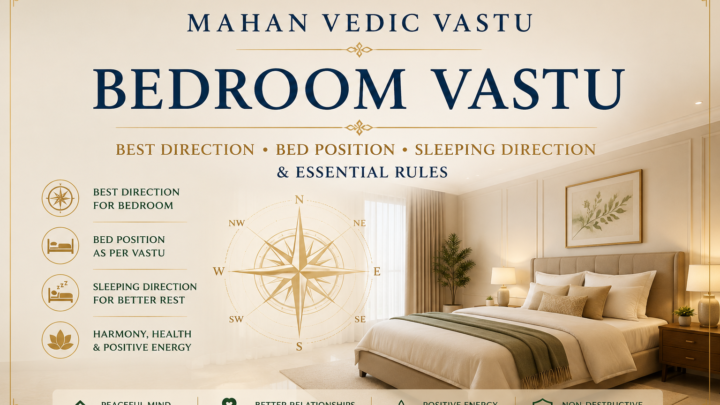
What Is the Best Direction for a Master Bedroom?
South-West is commonly considered for the master bedroom because of its association with stability and grounding.
However, bedroom Vastu also involves more than room location.
Bed position, sleeping orientation, doors, windows, mirrors, attached toilets and the overall geometry of the room may also be considered.
Therefore, “South-West bedroom” alone does not automatically make the entire bedroom Vastu-compliant.
Which Direction Is Best for a Pooja Room?
North-East is commonly associated with prayer, meditation and contemplative activities.
Where the layout permits, this can be considered when planning a pooja or meditation area.
In existing homes, however, practical limitations should be respected.
Vastu should be used to understand and improve a space—not to create unnecessary anxiety when a textbook-perfect arrangement is impossible.
What Is the Brahmasthan?
In addition to the directional zones, the central region of the building is an important concept in traditional Vastu.
It is commonly referred to as the Brahmasthan.
The centre should be studied as part of the overall spatial organisation rather than treated as just another compass direction.
Its usage, structural load, circulation and relationship with surrounding zones can form part of a complete Vastu assessment.
16 Vastu Zones vs 32 Entrances
These two concepts should not be confused.
16 Vastu zones divide the complete directional field of the property into sixteen sectors.
32 entrance divisions provide greater precision when evaluating positions around the perimeter, particularly the location of an entrance.
Therefore:
16 zones = detailed spatial analysis
32 entrances = more precise entrance-location analysis
Both are useful, but they answer different questions.
How Do You Find the Directions of Your House?
For a basic understanding, a compass can help identify North and establish the broad orientation of a property.
But professional analysis requires greater care.
Common errors include:
- measuring from an unsuitable location
- relying on a single unstable phone-compass reading
- confusing the building’s orientation with the door position
- treating the entire wall as one direction
- ignoring angular deviation
- analysing a rough sketch rather than an accurate floor plan
When an important decision depends on a few degrees of difference, precision becomes increasingly important.
Why a Floor Plan Matters in Vastu Analysis
A proper floor plan allows the practitioner to understand how the directional grid relates to the actual building.
Without it, someone may say:
“My kitchen is in the South-East.”
But where does the room actually begin and end?
Does it extend into East-South-East?
Where is its centre?
Where are the stove and sink?
What occupies the neighbouring zones?
The floor plan helps convert broad directional knowledge into meaningful spatial analysis.
Common Mistakes When Using Vastu Directions
One of the biggest mistakes is judging the entire home from a single direction.
Other common errors include:
- assuming every North-facing house is automatically good
- assuming every South-facing house is automatically bad
- identifying the direction without locating the exact zone
- judging the entrance only by the house-facing direction
- moving rooms based on generic online tips
- ignoring the actual floor plan
- treating one Vastu rule as more important than the complete layout
- making major structural changes before understanding the real issue
Vastu becomes more useful when the building is studied as an interconnected system rather than as a collection of isolated rules.
Can Vastu Be Improved Without Demolition?
In many existing homes, complete reconstruction is neither necessary nor practical.
The first step should be to identify whether a meaningful imbalance actually exists.
Depending on the property, practical improvements may involve better use of existing spaces, repositioning movable elements, adjusting functional usage or applying suitable non-destructive corrections.
The appropriate approach depends on the actual floor plan.
Generic remedies should therefore not replace individual analysis.
For personalised assessment, visit our Vastu Consultation page
Learn More About Vastu Shastra
If you are beginning your study, continue through the Mahan Vedic Vastu Vastu Guides, where we are building structured educational resources on home Vastu, entrances, directions, rooms and other important concepts.Explore Vastu Guides
For a broader introduction to residential Vastu, also read:
Vastu Shastra for Home: Complete Guide to Directions, Rooms & Entrance
These articles are designed to work together rather than as isolated Vastu tips.
Learn Vastu Systematically
Reading individual articles is useful for understanding individual concepts.
Professional study requires something more structured.
A systematic learning pathway should connect directions, zones, entrances, five elements, room placement, floor-plan analysis and practical case interpretation rather than memorising isolated rules.
If you want to study Vastu in a structured manner, explore the:
Mahan Vedic Vastu Vastu Course
When Should You Consider a Professional Vastu Consultation?
General educational guidance may be sufficient when you simply want to understand Vastu principles.
Individual consultation becomes more useful when you are:
- buying a plot
- selecting a house or apartment
- planning a new home
- constructing a building
- renovating an existing property
- evaluating an office or commercial space
- uncertain about an entrance
- dealing with multiple conflicting Vastu factors
- looking for practical corrections without unnecessary demolition
In these situations, the complete layout should be considered rather than applying generic internet advice one rule at a time.
Frequently Asked Questions
What are the 8 directions in Vastu?
The eight principal directions are North, North-East, East, South-East, South, South-West, West and North-West. They provide the broad directional framework used in Vastu analysis.
What are the 16 Vastu zones?
The sixteen zones are N, NNE, NE, ENE, E, ESE, SE, SSE, S, SSW, SW, WSW, W, WNW, NW and NNW. They divide the full 360-degree space into sixteen sectors of 22.5 degrees each.
Why are 16 directions used in Vastu?
The sixteen-zone system provides greater precision than the eight-direction model. It helps distinguish spaces that may appear to occupy the same broad direction but actually fall within different directional sectors.
Which direction is best for a house according to Vastu?
There is no need to judge an entire house from its facing direction alone. Entrance position, internal room placement, directional zones, building geometry and other factors should be considered together.
Is a South-facing house bad according to Vastu?
Not automatically. Calling every South-facing house bad is an oversimplification. The exact entrance location and overall floor plan are more important than the facing label alone.
Which direction is best for the kitchen as per Vastu?
South-East is traditionally associated with fire and is commonly considered for the kitchen. However, the exact kitchen zone, stove, sink and complete floor plan should also be evaluated.
Which direction is best for the master bedroom?
South-West is commonly considered for a master bedroom because it is traditionally associated with stability and grounding. Bedroom layout and other factors should also be considered.
Which direction is best for a pooja room?
North-East is traditionally preferred for prayer, meditation and contemplative activities where the building layout permits.
Are 16 Vastu zones and 32 entrances the same?
No. Sixteen zones divide the directional field of the property, while the 32 entrance divisions provide more detailed analysis of entrance locations around the perimeter.
Can I check my home’s Vastu using a compass app?
A compass app can help with preliminary orientation, but measurement errors, magnetic interference and floor-plan inaccuracies can affect detailed analysis. Important property or renovation decisions benefit from more precise assessment.
Can Vastu corrections be done without demolition?
In many cases, practical non-destructive corrections may be considered after the actual floor plan and nature of the imbalance are properly analysed. Major structural changes should not be made merely from generic online advice.
Final Thoughts
Understanding Vastu directions for home is not about labelling one direction as lucky and another as unlucky.
The more useful approach is to understand what each part of the building is being used for and how that function relates to the overall directional framework.
The 8 directions provide the foundation. The 16 Vastu zones provide greater precision. Entrance analysis can go further through the 32 entrance divisions.
Together, these concepts help transform Vastu from a collection of general tips into a more structured method of spatial analysis.
Continue your learning through the Vastu Guides, explore the Vastu Course for systematic study, or choose a Vastu Consultation when your own property requires individual analysis.
This article presents Vastu Shastra as a traditional system of spatial planning and interpretation for educational purposes. General Vastu information should not be treated as a substitute for property-specific architectural, structural, engineering, financial, legal or other professional advice.